
![[Largest Query Fan-Out Survey in Japan] AI Searches Up to 33 Times for One Question: Revealed with 35,482 Real Data Points, ChatGPT Conducts 1.6 Times More 'Background Searches' than Gemini](/_next/image?url=https%3A%2F%2Ftauktlyjhposmxktqdbh.supabase.co%2Fstorage%2Fv1%2Fobject%2Fpublic%2Fblog-assets%2Fthumbnails%2F1788923188288-241f5jtc62c.png&w=3840&q=75)
[First in Japan] Queue Ltd. conducts a large-scale survey on the reality of AI's 'Query Fan-Out (QFO)'. Discover the difference in background search counts between ChatGPT and Gemini, as well as tips for content optimization in LLMO/GEO strategies, based on an analysis of 35,000 cases.
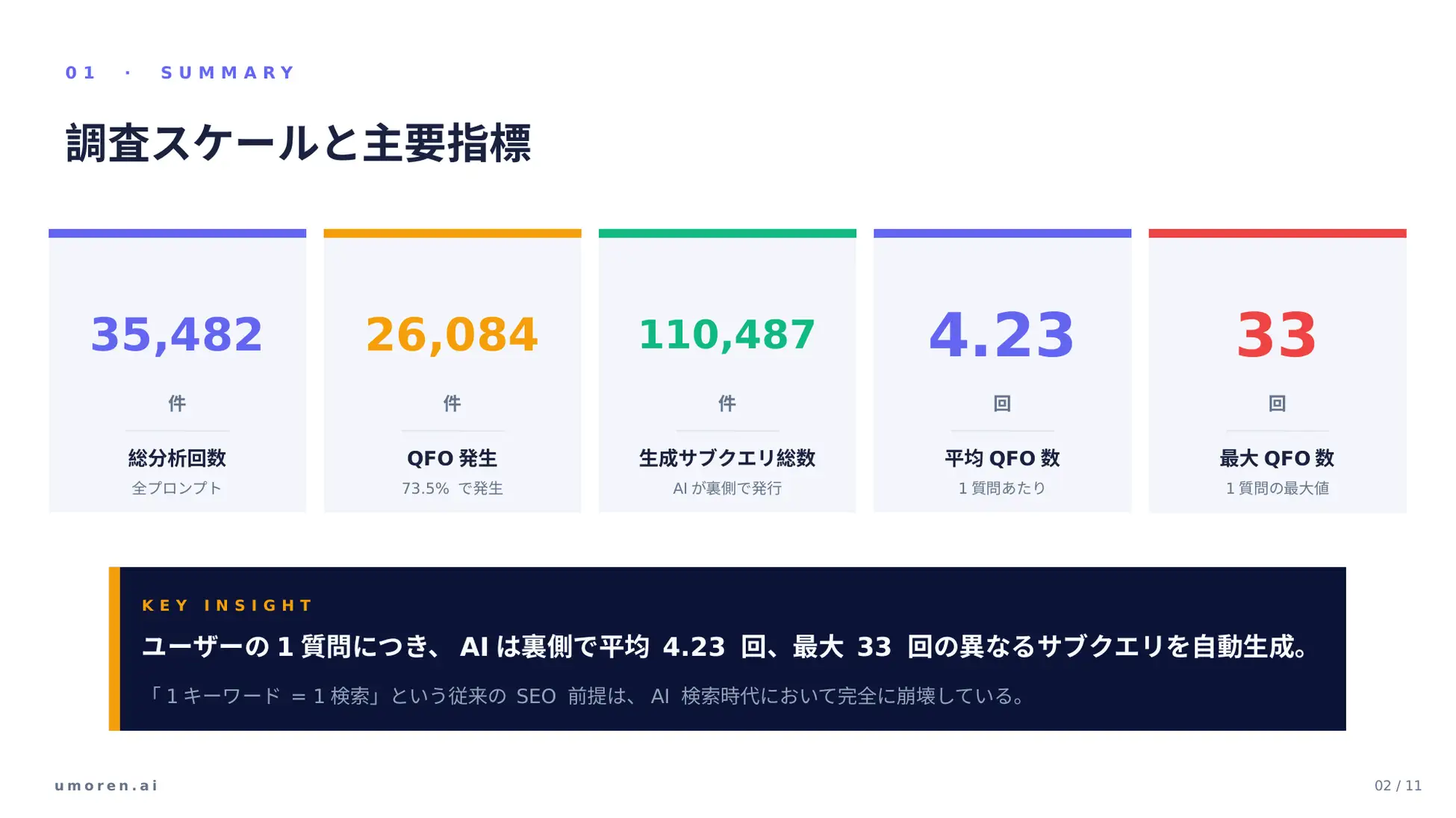
Queue Ltd. (Headquarters: Chuo-ku, Tokyo, CEO: Taichi Taniguchi, URL: https://queue-tech.jp/) has announced the results of a large-scale survey analyzing the behavior of AI's 'Query Fan-Out (QFO)' using a total of 35,482 prompts submitted to their free QFO analysis tool during the period from February 5 to May 27, 2026.
The survey revealed that ChatGPT and Gemini automatically generate an average of 4.23 different sub-queries, with a maximum of 33, for one user question to gather information. Furthermore, ChatGPT issues about 1.6 times more sub-queries than Gemini, highlighting fundamental differences in QFO behavior between AI search engines. As far as the company is aware, this is the first quantitative analysis of QFO on such a scale in Japan.
■ Background of the Survey: Why 'QFO' is Important Now
When users ask ChatGPT or Gemini a question, the AI breaks down the single question into multiple search queries (fan-out) behind the scenes, searches each one, and integrates the obtained information to generate an answer. This entire mechanism is known as 'Query Fan-Out (QFO)'.
Traditional SEO was based on optimizing a single page for 'one keyword entered by the user'. However, in the era of AI search, since AI itself automatically generates multiple search queries behind the user's input, 'which sub-query retrieves and cites your content' becomes the key to exposure.
Until now, there has been no large-scale quantitative analysis of how often and in what patterns this QFO occurs in Japan. The company has decided to publish empirical data for the first time, utilizing the large-scale real usage data collected by their free QFO analysis tool, to help Japanese marketers, SEO managers, and content providers formulate LLMO/GEO strategies.
| Item | Content |
| Survey Name | Query Fan-Out (QFO) Reality Survey 2026 |
| Survey Target | User prompts executed on the umoren.ai free QFO analysis tool |
| Target AI Engines | ChatGPT, Gemini |
| Survey Period | February 5, 2026 - May 27, 2026 (about 3.5 months) |
| Total Analysis Count (N) | 35,482 cases |
| Total Number of Generated Sub-Queries | 110,487 cases |
| Survey and Analysis Entity | Queue Ltd. (operator of umoren.ai) |
■ Six Major Findings
Finding 1: AI Searches 'An Average of 4.23 Times, Up to 33 Times' for One Question
When a user asks AI one question, the AI generates an average of 4.23 different sub-queries behind the scenes to gather information. In the most frequent case, 33 sub-queries were issued for one question, quantitatively demonstrating that the SEO premise of '1 keyword = 1 search' has completely collapsed in the AI search era.
In total, 110,487 sub-queries were generated from 35,482 prompts, which means that 'about 3.1 times the search per question' is being executed behind the scenes by AI.
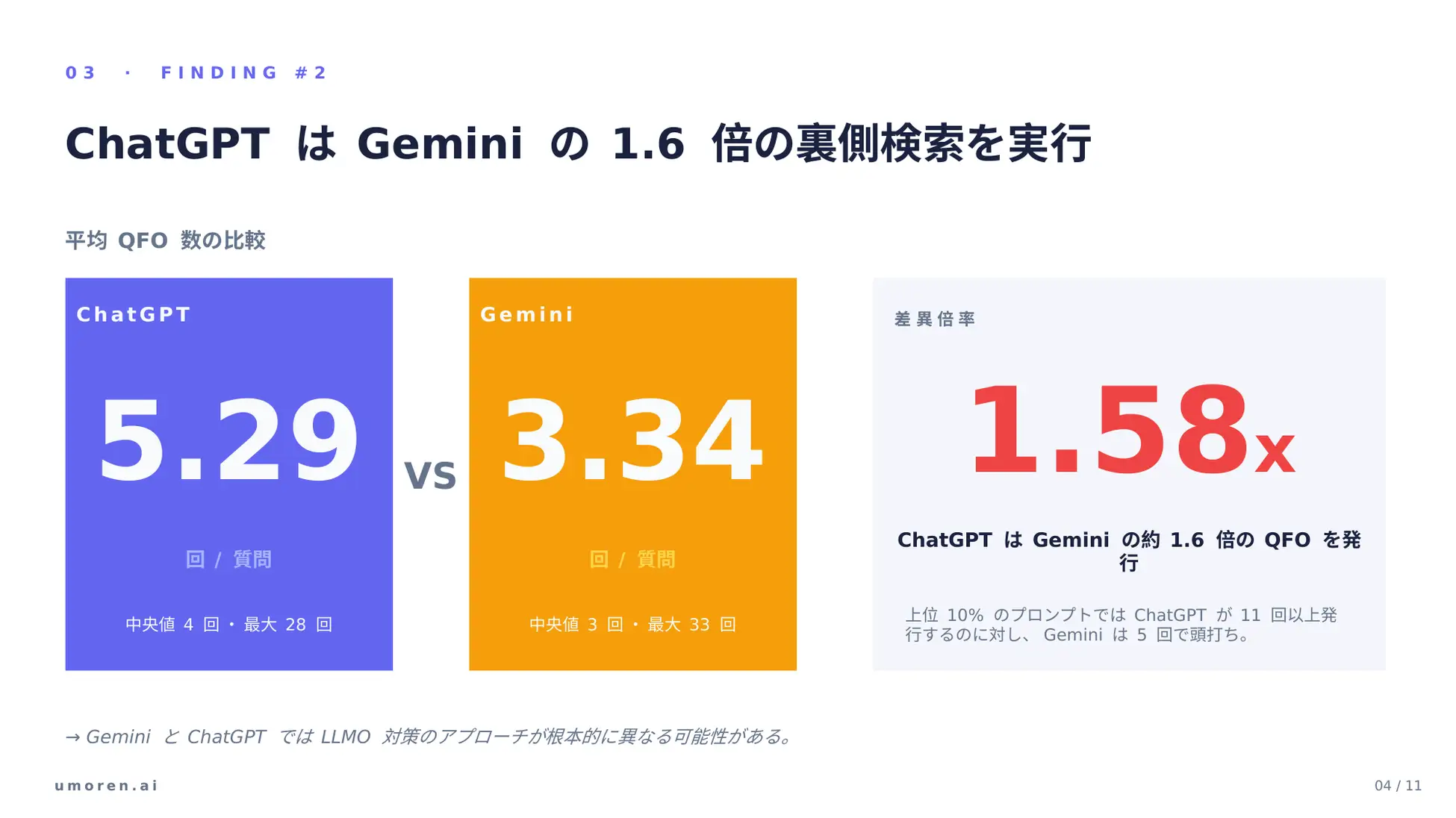
Finding 2: ChatGPT Executes 'About 1.6 Times' More Sub-Searches than Gemini
Comparing the average QFO count, ChatGPT had 5.29 times, Gemini had 3.34 times, confirming a significant difference of about 1.58 times more for ChatGPT. Even looking at the median, ChatGPT executed more background searches with 4 times compared to Gemini's 3 times.
Finding 3: 'High QFO' of 7 or More is Almost Exclusively ChatGPT's Domain
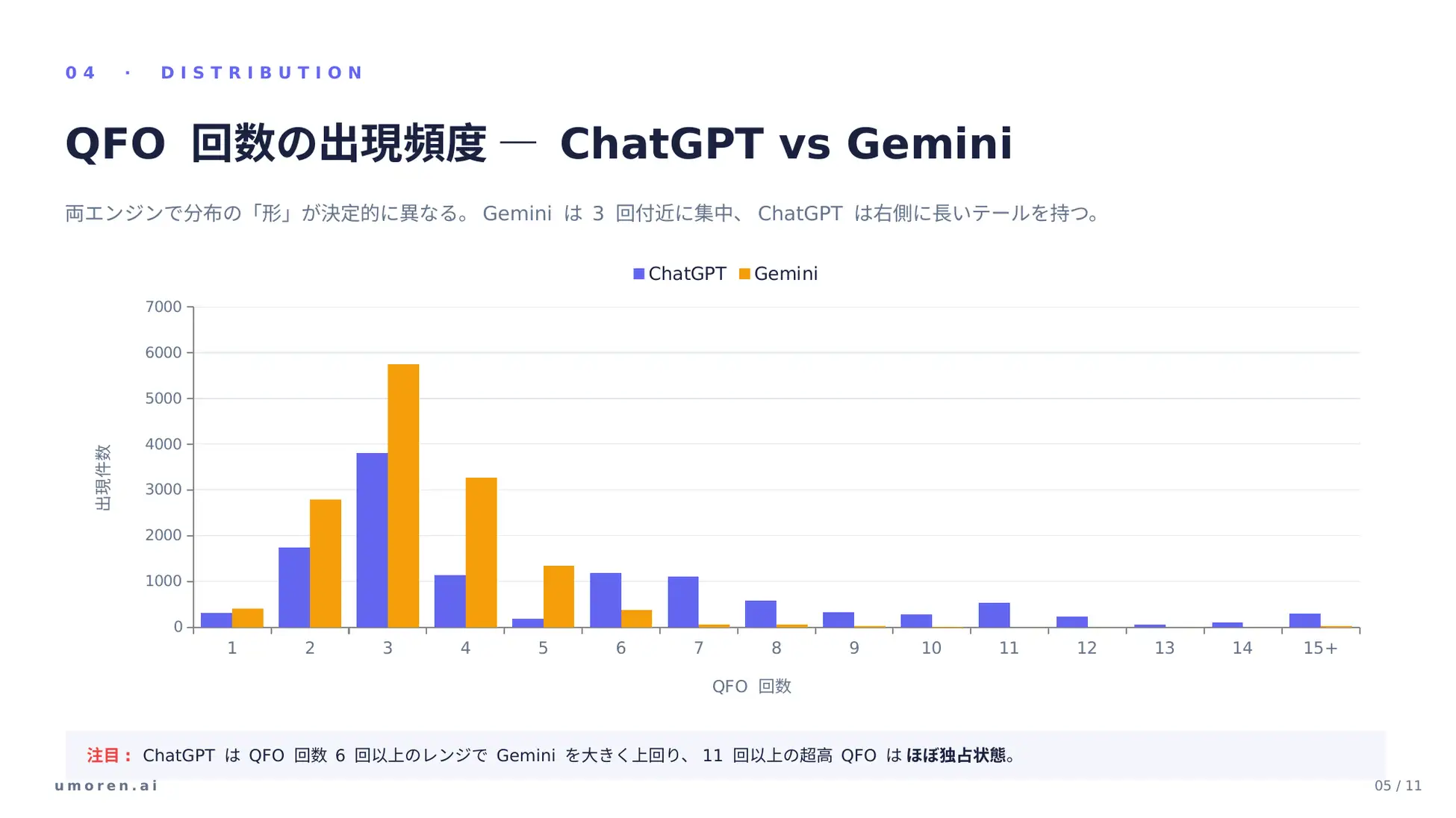
When classifying the fan-out count into four tiers: 'Low (1-3 times)', 'Medium (4-6 times)', 'High (7-10 times)', and 'Ultra-High (11 times or more)', it was found that 93.5% (2,304 cases) of 'High QFO' cases of 7 or more occurred with ChatGPT, while only 6.5% (158 cases) occurred with Gemini.
Focusing further on 'Ultra-High QFO' of 11 or more, ChatGPT accounted for 10.9% compared to Gemini's 0.2%, a difference of about 55 times, revealing that QFO behavior differs not only in 'quantity' but also 'qualitatively' between AI search engines.
Finding 4: As Prompts Become More Detailed, QFO Increases 'About 2 Times'
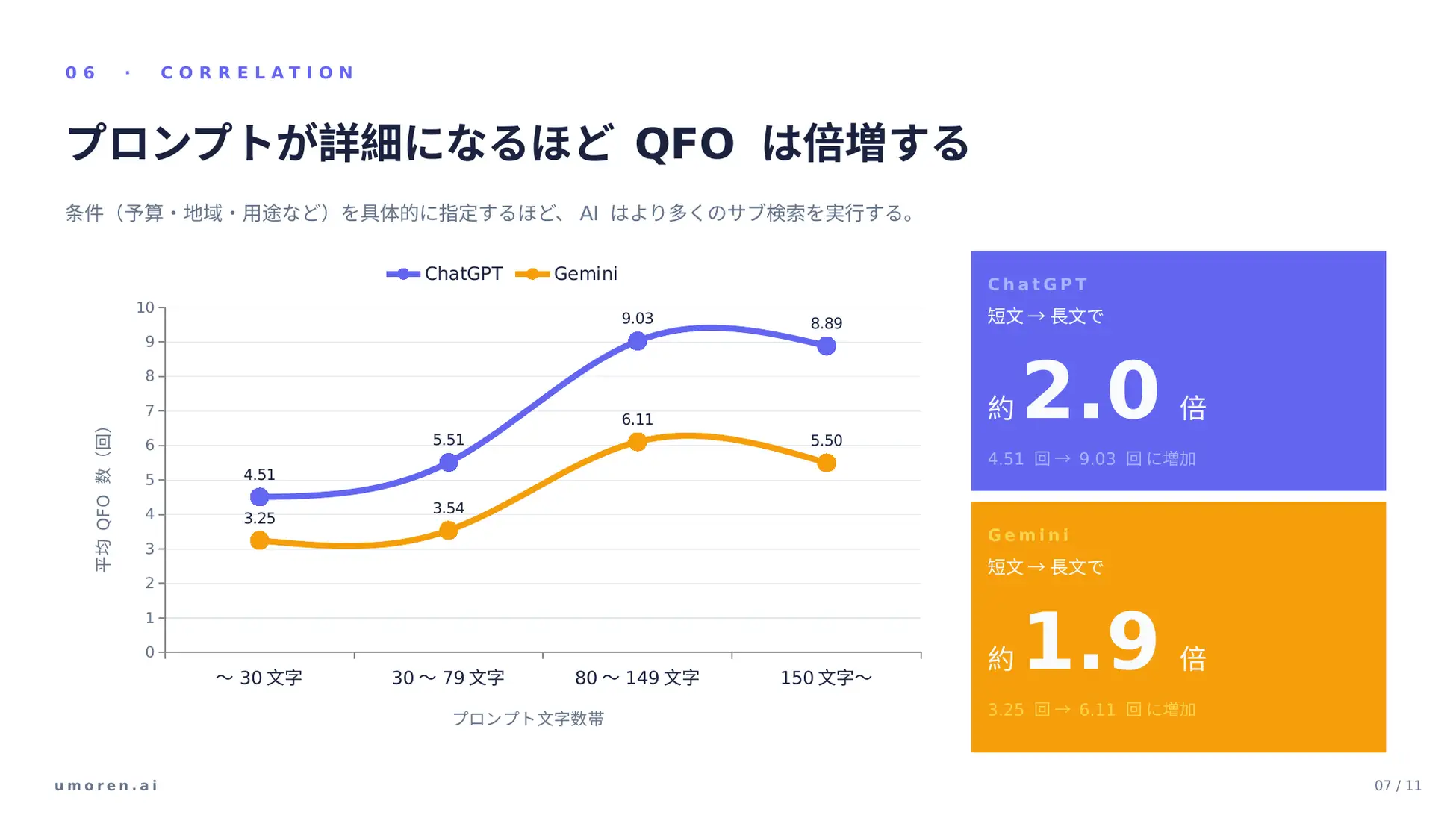
Analyzing the correlation between prompt length and QFO count revealed that the number of sub-queries issued by AI significantly increases as prompts become more detailed.
ChatGPT: Short text (less than 30 characters) average 4.51 times → Long text (80 characters or more) average 9.03 times (about 2.0 times)
Gemini: Short text average 3.25 times → Long text average 6.11 times (about 1.9 times)
The more users write specific conditions such as 'budget', 'region', and 'purpose', the more AI breaks down each condition into sub-queries and searches individually. This provides a very important insight for content optimization, showing that 'conditional searches' generate more queries behind the scenes than 'nominated searches'. 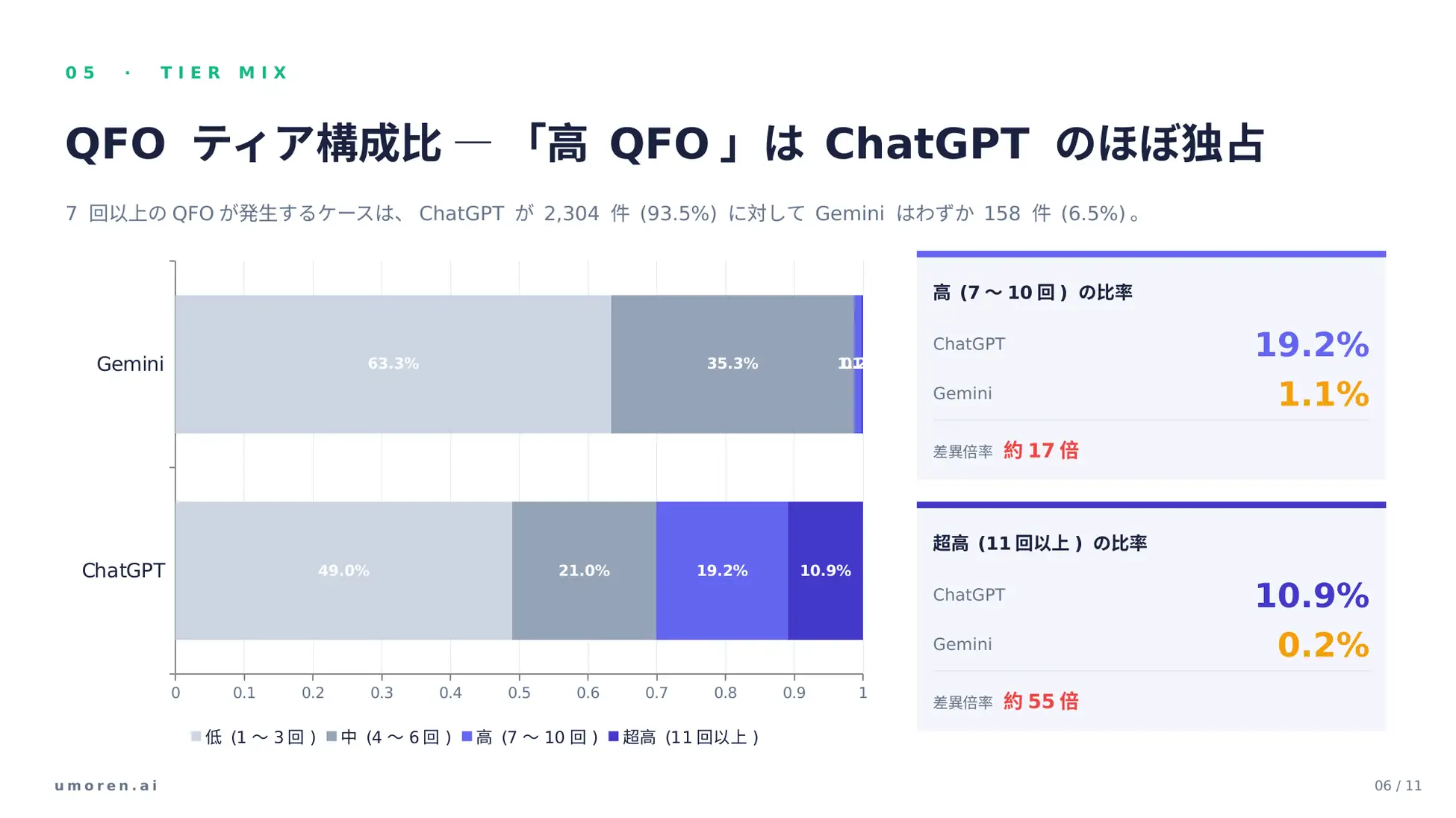
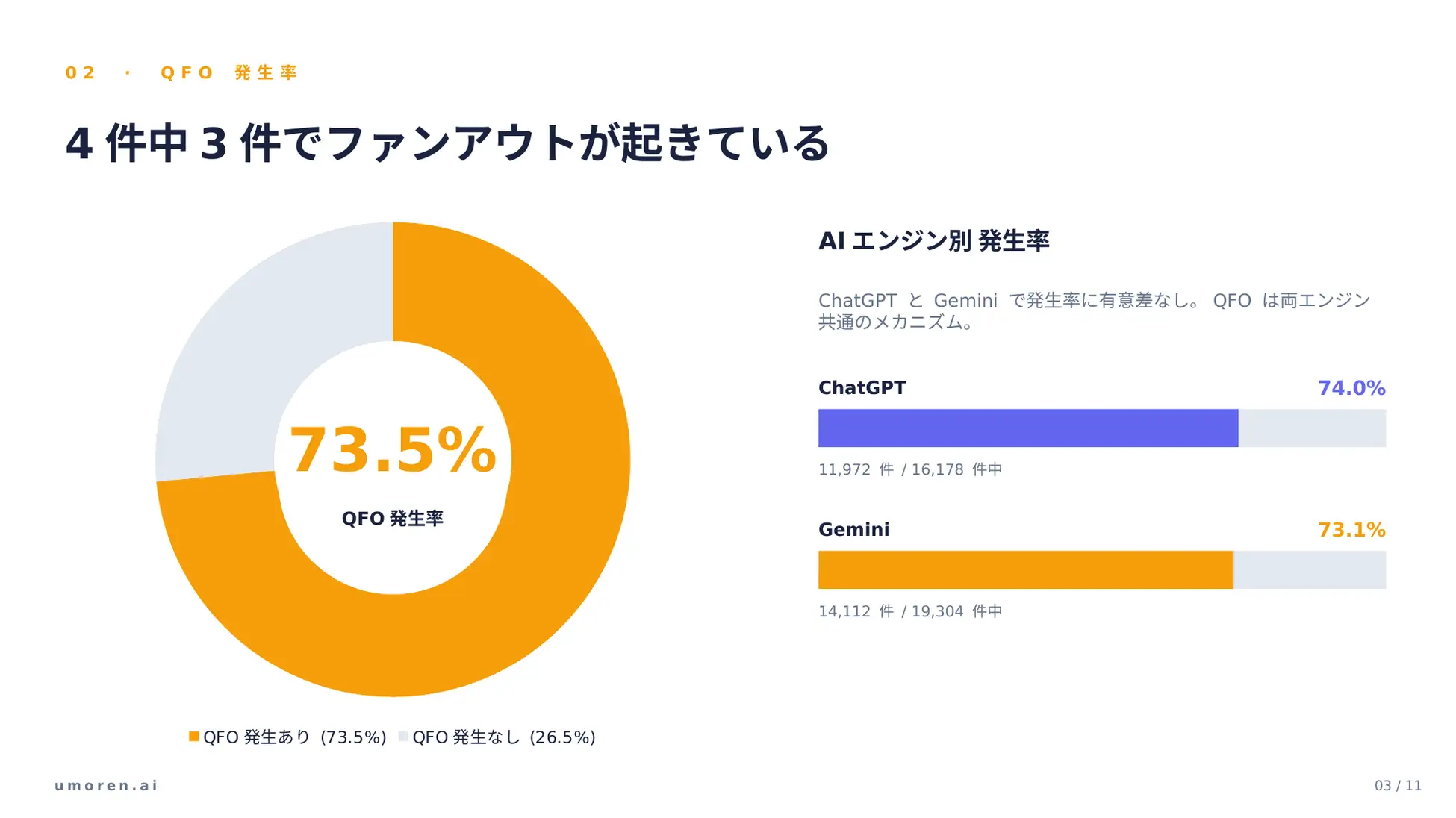
Finding 5: QFO Occurrence Rate is '73.5%' — It Occurs in 3 Out of 4 Cases
Out of 35,482 analyses, QFO occurrence was observed in 73.5% (26,084 cases). With ChatGPT at 74.0% and Gemini at 73.1%, there is almost no difference in occurrence rates between the two engines, confirming that QFO is not a 'special behavior' but a standard mechanism in AI search.
Finding 6: The Distribution is Skewed to the Right, and QFO 'Explodes' in Some Prompts
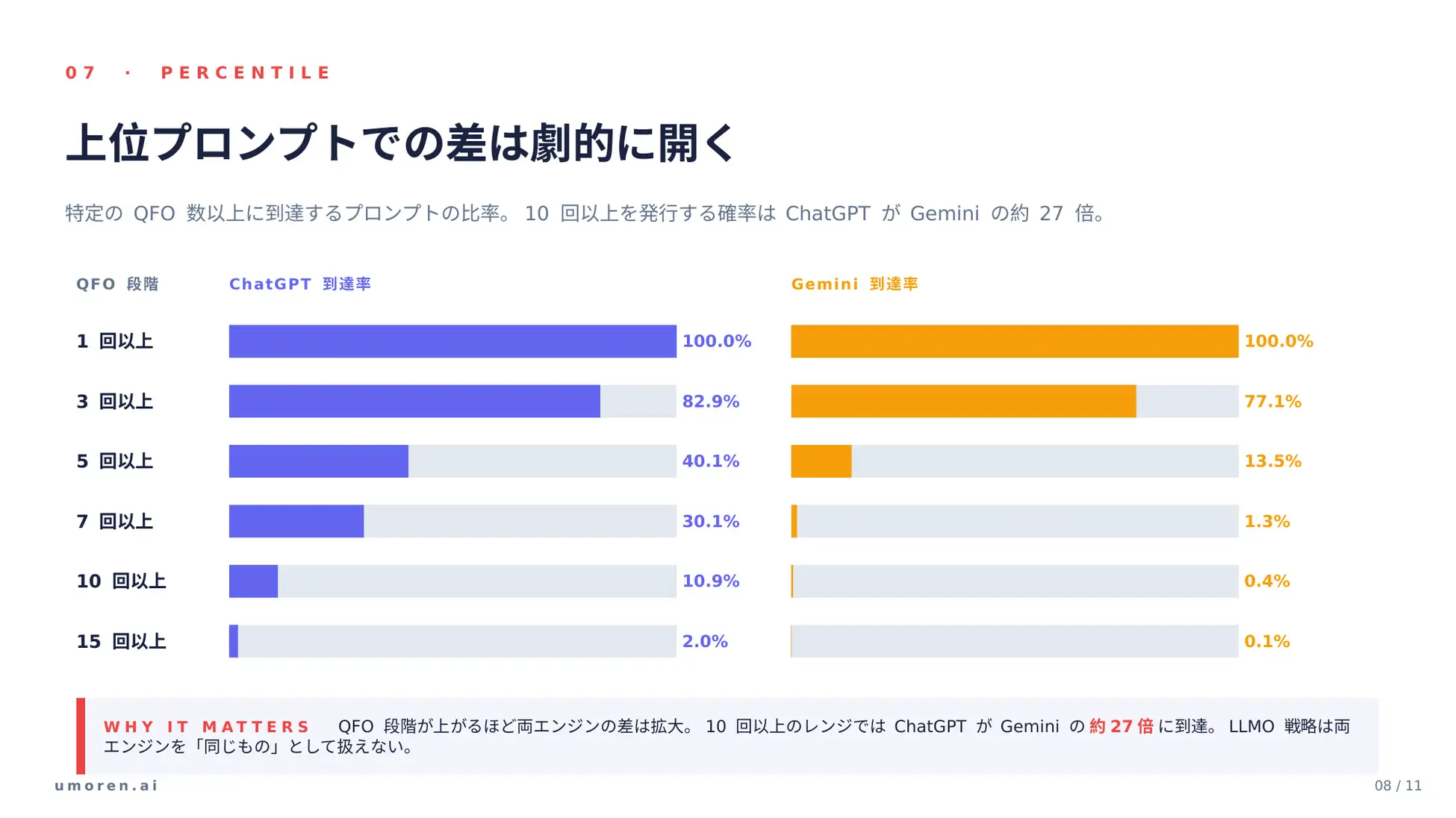
The mode of QFO count is 3 times, but the average is 4.23 times. This means that 'a small number of high QFO prompts are raising the average', and certain types of questions have the characteristic of generating an explosively large number of sub-queries by AI.
Especially with ChatGPT, the top 25% of prompts issue 7 or more QFOs, and the top 10% issue 11 or more.
■ Considerations: Three Actions Companies Should Take in the LLMO/GEO Era
The results of this survey provide three important insights for content and SEO strategies in the AI search era.
① 'Visualizing QFO' is the First Step in Optimization — Without understanding 'how many times' and 'with what queries' AI is searching behind the user questions you envision, you cannot stand at the starting point of optimization.
② Strategies Need to be Designed Separately for Each Engine — ChatGPT and Gemini have fundamentally different QFO behaviors. It is not possible to optimize both engines simultaneously with one measure, and differentiated strategy design based on engine characteristics is required.
③ Optimization at the Sub-Query Level is the Key to Exposure — Designing your content to be retrieved and cited for each of the multiple sub-queries generated behind a user's question is the new exposure strategy in the AI search era.
■ Offering a 'QFO Analysis Tool' That Anyone Can Try for Free
At umoren.ai, we have released a tool that allows you to measure the QFO behavior of your prompts for free using the same mechanism as this survey. Marketers, SEO managers, and content providers can instantly check what sub-queries AI generates behind the user questions they envision by simply entering them.
ChatGPT Version QFO Analysis Tool (Free) https://umoren.ai/free-tools/chatgpt-query-fanout
Gemini Version QFO Analysis Tool (Free) https://umoren.ai/free-tools/query-fanout