

What is AI search and how does it differ from traditional search? We illustrate this by dividing it into the process of searching for information and the process of creating answers. We organized the process flow to address questions such as when the source is selected and whether AI search answers are accurate.
AI search is a mechanism divided into two processes: searching for external information in response to a question and creating an answer from the gathered information. In the first half, external information is searched, and in the second half, a sentence is constructed from that information. By distinguishing the former as the information retrieval layer and the latter as the answer generation layer, you can continuously follow what is happening internally.
This separation is effective in practice because the visibility of your site is determined by different conditions for each layer. Whether a page becomes a candidate is determined in the retrieval layer, and how its content is rephrased into an answer sentence is determined in the generation layer. The issues and areas to fix differ between pages that fall in the retrieval layer and those that are retrieved but not selected as citations.
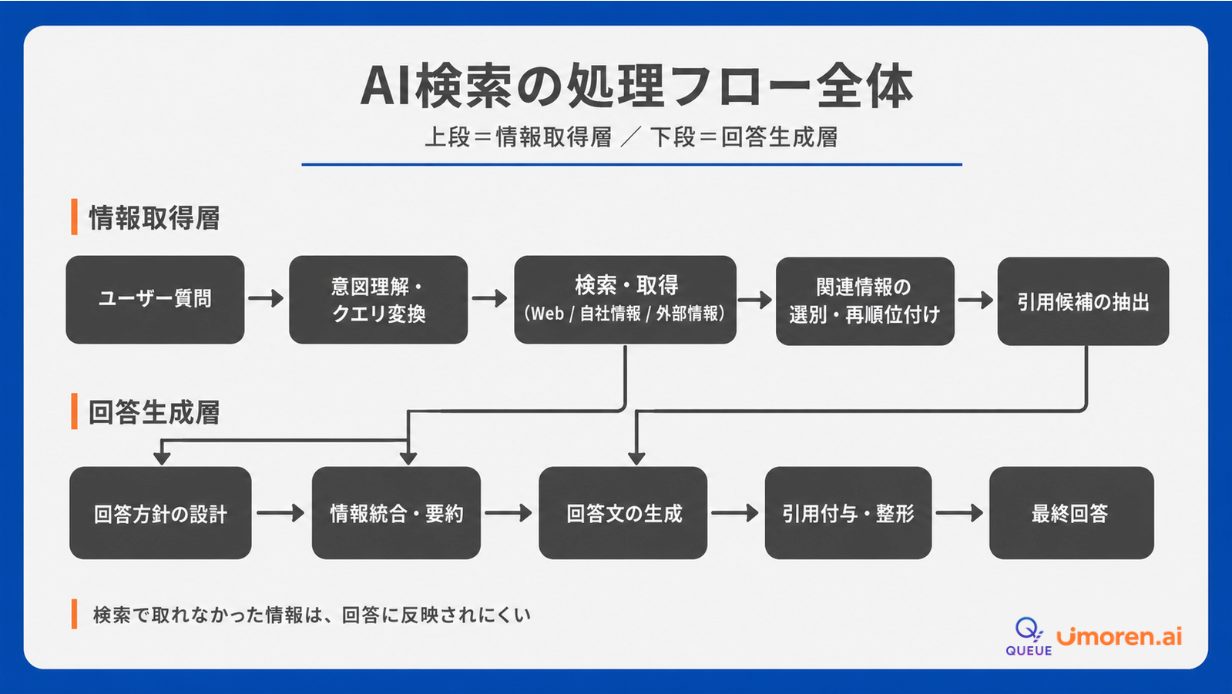
The scope referred to by the term AI search is broad, with implementations varying by service, including Google's AI Overviews, conversational AI Mode, ChatGPT search, Perplexity, and Gemini. However, the framework of "interpreting the question, retrieving external sources, and constructing a sentence based on that content" is common. By understanding this framework before delving into individual specifications, you can avoid having to relearn every time a feature is updated.
How the evaluation structure of search engines themselves has changed in the AI search era is explained in detail in the related article 'What is SEO? Understanding the Causes of Ineffectiveness and Strategies for the AI Search Era'.
From here, we will sequentially follow what happens in the two layers and finally break it down to the point where you can distinguish "at which stage your company's page is stopping".
Information Retrieval Layer: From Question Decomposition to Fragment Selection
The role of the information retrieval layer is to gather materials to pass to the generative AI. This layer is divided into three movements: question decomposition, candidate search by meaning, and fragment narrowing.
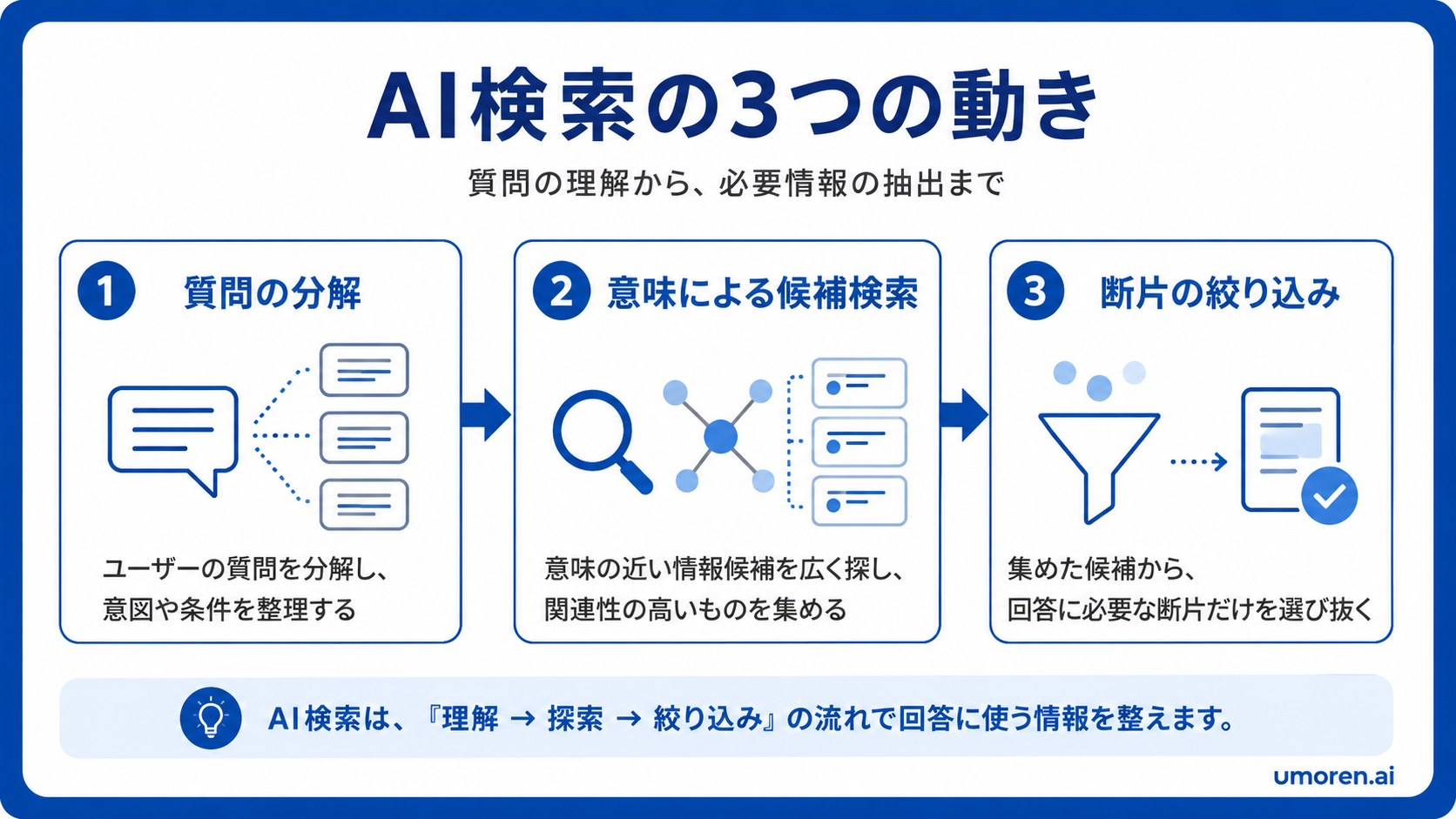
Questions Are Not Searched in Their Original Form
The questions entered by users are often not searched as they are. Behind a single question like "the mechanism of AI search," it is broken down into multiple sub-questions such as "What is AI search?", "How does it differ from traditional search?", and "How are sources selected?", and searches are conducted for each. Google refers to this decomposition process as QFO (Query Fan-Out) in its explanation of AI Mode.
As a result of the decomposition, there is not just one entry point for a single article to be picked up. It is not only whether the entire article fits the theme but also whether each heading within the article answers the individual questions after decomposition that matters. The heading structure works as a matching surface with sub-questions, not just for the table of contents.
If you want to confirm how many times decomposition actually occurs, refer to the related article '【The Largest Query Fan-Out Survey in Japan】AI Searches Up to 33 Times Behind One Question'.
【umoren.ai】 Free QFO Analysis Tool
Visualize sub-search words.
Gathering by Semantic Proximity, Not Textual Match
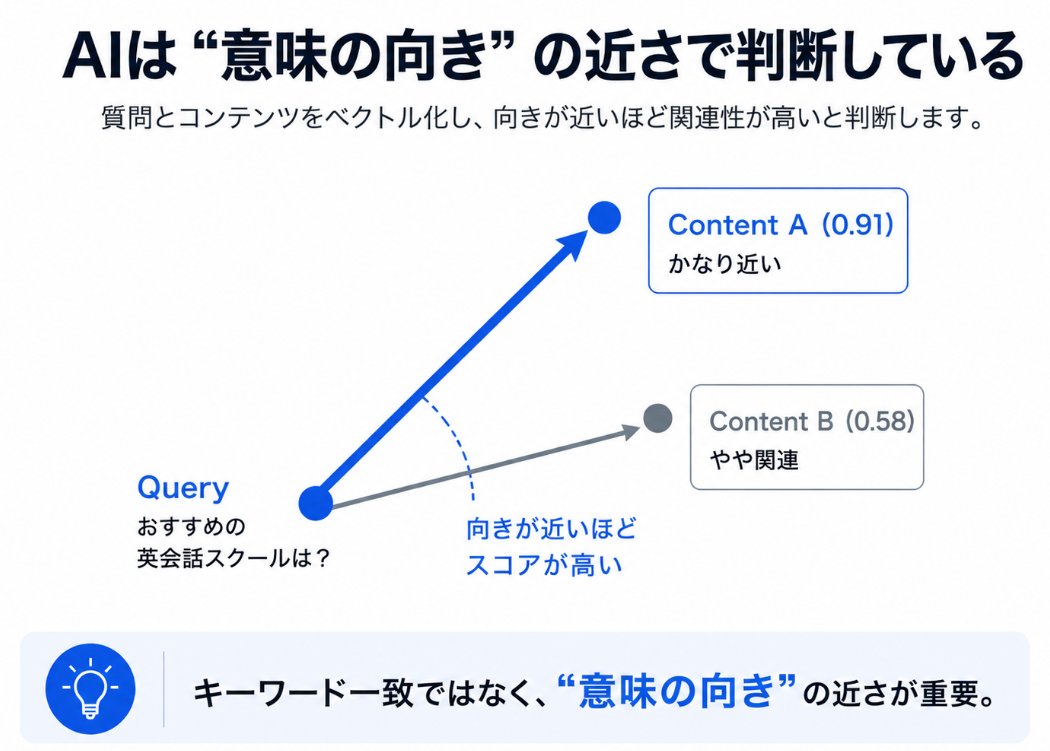
The decomposed questions are matched not only by word match but also by semantic proximity. Vectors are used here. Through the process of converting sentences into sequences of numbers (embedding), the proximity between the numbers on the question side and the page side is measured using cosine similarity, etc.
In simple terms, while keyword search looks at "whether the same words are written," vector search looks at "whether the same thing is being said." Therefore, even pages that do not write the words "AI search mechanism" verbatim may be candidates if they explain the process flow. Conversely, pages that just list keywords without substance do not reduce the semantic distance and are excluded from candidates.
In practice, a hybrid configuration combining keyword match methods (like BM25) and vector search is common. It is worth noting that decisions are not made based on just one of these methods.
Fragments, Not Pages, Are Extracted
The gathered information is handled not at the page level but at the level of smaller fragments. This division is called chunking. Long articles are cut into multiple chunks, and only chunks close to the question remain, from which rankings are reassigned (re-ranking).
This is a key point of understanding. In traditional search, the conclusion was "which page to show," but in AI search, the conclusion is "which fragment to use as material." Even if an article is excellent as a whole, if a single extracted paragraph does not make sense on its own, it is less likely to be chosen as material.
Answer Generation Layer: From Gathered Fragments to Constructed Answers
The narrowed-down fragments are passed to the generative AI along with the question sentence. This is where the answer generation layer begins.
Creating Sentences Based on Provided Materials
The generative AI reads the provided fragments as context and constructs an answer sentence to the question. This "searching for external information before answering" structure is known as the RAG (Retrieval-Augmented Generation) framework proposed by Lewis et al. in 2020. The generation itself is handled by large language models (LLMs) based on the Transformer by Vaswani et al. (2017).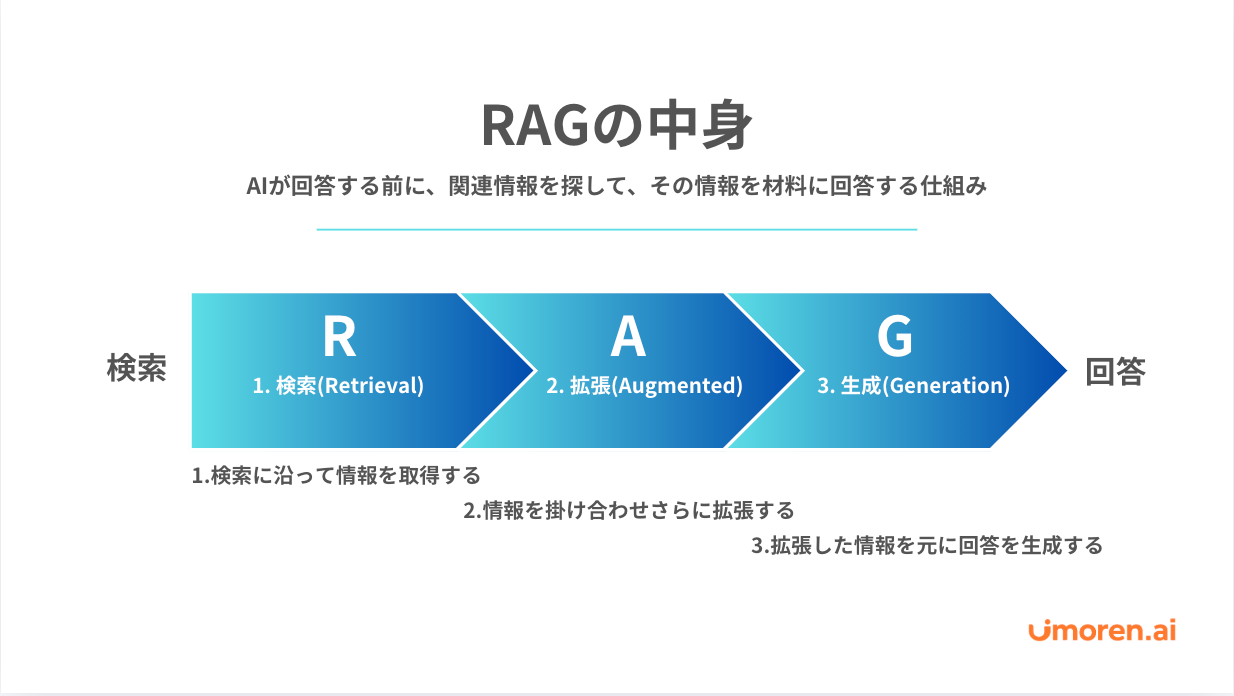
It is important to note that this layer is not a place to introduce new facts. What the generative AI does is integrate and rephrase the provided materials. Content not included in the materials is filled in by the knowledge obtained during the model's training or by inference. The weight that influences the quality of the answer leans more towards the materials than the skill of the generation.
Linking Answers to Information Sources
The process of linking answers to real information sources is called grounding. It is a mechanism that associates each part of the answer sentence with the fragment it originates from and presents it as a citation. This association is why AI search answers are accompanied by reference links.
However, the linkage to information sources is not one-to-one. Since multiple information sources are integrated during the summarization process, the presented citation is not necessarily the sole origin of that sentence. Even if your company's site is displayed as a citation, it cannot be determined from the outside which part of the answer sentence originates from your company's description.
The Cause of Discrepancies Often Lies in the Retrieval Layer
The phenomenon of generating content that differs from the facts is called hallucination. While often discussed as a performance issue of generative AI, following the process flow reveals that the cause often lies in the retrieval layer. Relevant information may not be indexed, only outdated descriptions may be picked up, or fragments may be cut at incomplete positions, missing conditional parts. In such states, no matter how carefully the generation layer constructs the answer, it will collapse, leading to the perception of lying.
If you have confirmed that your company's information is incorrectly described on AI search, refer to the related article 'Risk Management and Practical Avoidance Techniques to Prevent Misinformation with AI Measures' for a breakdown of the causes and countermeasures.
Let's Diagnose How Your Company is Mentioned by AI (Free)
umoren.ai / Free Tool
Parts Overlapping with Traditional Search Engines and Parts That Have Changed
AI search has not replaced traditional search engines but has layered on top of them. The foundation of crawling and indexing is shared, and pages not indexed are not handled by AI search either.
|
Process |
Traditional Search |
AI Search |
|
Crawling and Indexing |
Necessary |
Uses the same foundation |
|
Question Interpretation |
Focus on matching input words |
Interpreted by semantic proximity and decomposed into sub-questions |
|
Narrowing Unit |
Page |
Fragments within a page |
|
Presentation Method |
List of links |
Summary and citation presentation |
|
User's Next Action |
Click and read |
Read the answer and visit only if necessary |
What has changed is the evaluation unit and the user's endpoint. Previously, the endpoint was high ranking, but in AI search, the endpoint is having your company's description included in the answer sentence. These two do not correlate. Pages that rank high but are not cited and pages that are repeatedly cited despite low rankings both exist. The divergence between high ranking and citation is a phenomenon unique to AI search.
Different Depths of Processing in AI Overviews and AI Mode
In the context of Google search, AI Overviews (formerly SGE) and AI Mode are often confused. The former is a summary displayed at the top of regular search results, while the latter is a search mode based on dialogue. Both use Gemini, but the depth of question handling differs.
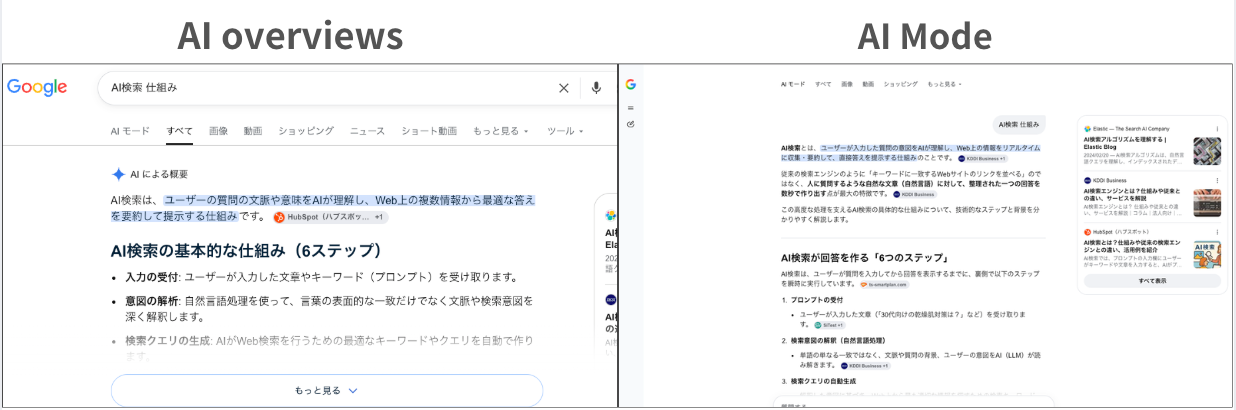
AI Overviews, being positioned as a summary of search results, strongly ties with the regular search index. AI Mode, through the aforementioned QFO (Query Fan-Out), expands more sub-questions and responds to multi-turn additional questions based on conversation history. Even with the same term "AI search," the former is closer to an extension of existing SERP, while the latter leans towards conversational search.
It is also worth recognizing that the internal processing of each service is not fully disclosed. What can be confirmed from public information is up to the framework, and the detailed behavior is supplemented by observation within the company.
Sources Are Narrowed Down Through Four Gateways
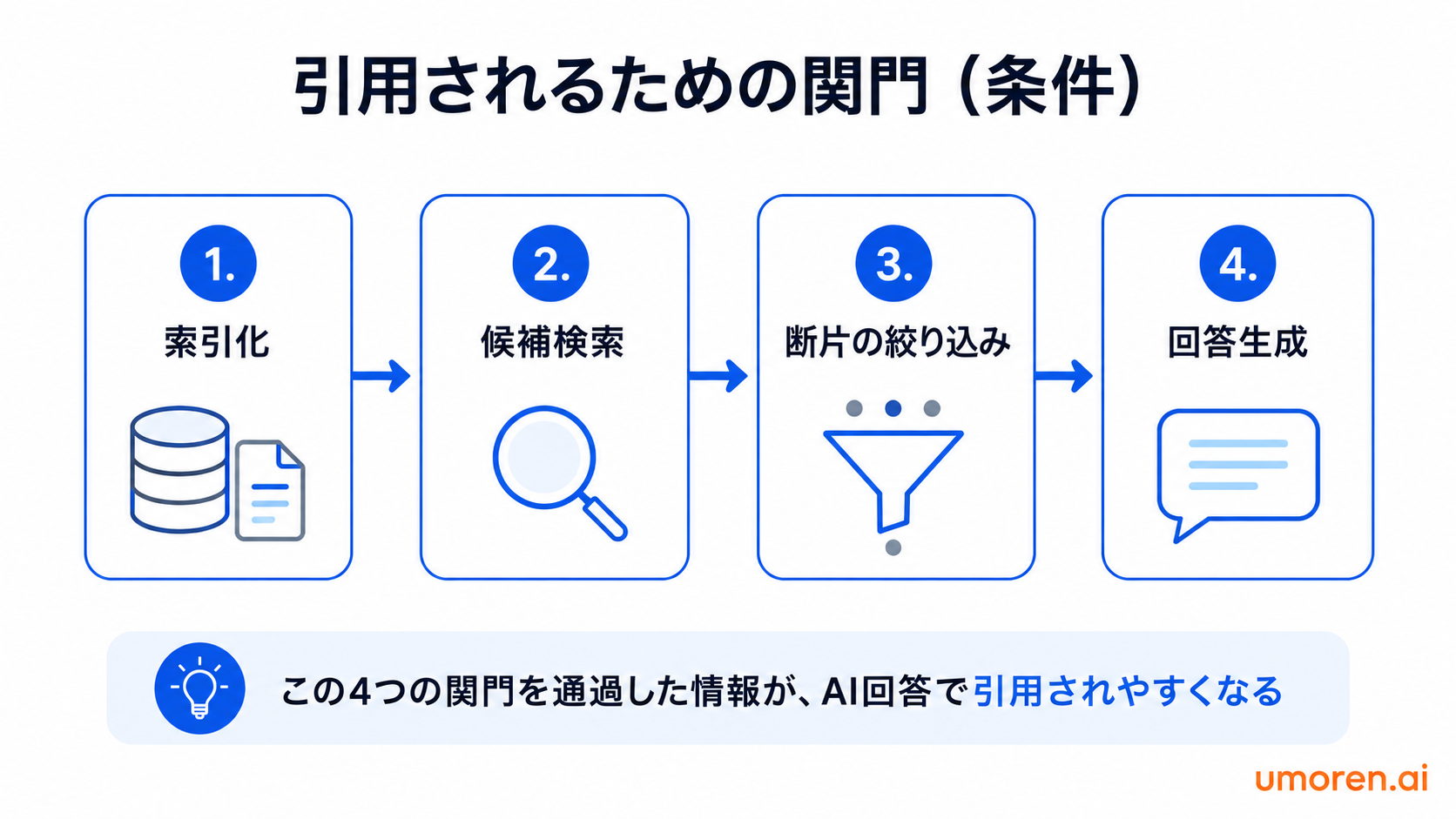
There is not just one "condition for being cited." Following the process flow, gateways to pass through are placed in stages, and the symptoms that appear differ depending on where you fall.
|
Gateway |
Condition for Passing |
Symptom When Failed |
|
① Indexing |
Crawled and indexed |
Does not appear in any AI search |
|
② Candidate Search |
Question meaning is close to page content |
High search ranking but not cited |
|
③ Fragment Narrowing |
Relevant part makes sense on its own |
Page is referenced but unintended sentences are cited |
|
④ Answer Generation |
Description is clear and withstands rephrasing |
Cited but summarized with a different intent |
The third and fourth stages are areas not addressed by traditional SEO.
What works in fragment narrowing is whether the extracted few hundred characters can be read independently. Writing styles with strong dependencies on preceding and following contexts, such as "as mentioned earlier" or "in contrast," are kind to humans reading through but lose meaning the moment they are extracted. Whether a definition sentence is complete with a subject and predicate in one sentence, or whether conditions and conclusions fit in the same paragraph, this level of one-sentence completeness is questioned here.
What works in answer generation is the clarity of the description. Expressions with implications or writing styles that allow multiple interpretations may be fixed to one interpretation during summarization, and presented in a form different from the intent. The influence of authority and the rarity of primary information on citation is ultimately due to the judgment of "whether the description withstands rephrasing."
As a means to actually check where your company's page is stopping among the four, Queue Corporation's Free AI Search Countermeasure Diagnosis is effective.
Even if referenced, the structure of not being visited and the limits of measurement
Understanding the process flow reveals that the difficulty of effect measurement is structural. If the user's question is resolved at the point the answer is generated, no visit will occur even if the citation source is displayed. The standard behavior is that references do not lead to visits.
Even when a visit occurs, the source information may be missing from the record. This state is called referrer loss, and it is counted as direct inflow, making it difficult to isolate the portion from AI search. Traditional metrics like display count and click rate are designed based on SERP, so they cannot directly count exposure within the answer sentence.
Therefore, measurement involves combining alternative indicators. Trends in branded searches, changes in direct inflow, and fixed-point observations of citation status when actually entering major question sentences. All have limited accuracy, and we are not at a stage where results can be discussed with a single figure. Conversely, if "inflow from AI search" is set as a reporting indicator without sharing this premise, the fact that numbers do not move becomes incorrect judgment material.
Why Answers Change Even with the Same Question
The output of AI search does not remain the same even if the same question is posed each time. Multiple factors overlap here.
The sub-questions into which it is decomposed are not fixed. If the combination of fragments retrieved changes, the materials change, and so does the answer. There is variability in the generation itself. Even from the same materials, there is a range in how sentences are constructed.
Depending on the nature of the question, there may be cases where the search is not called at all. For questions asking for general definitions, external searches may not be conducted, and answers may be given using only the model's internal knowledge (pre-training), in which case no citation source is shown, and information from the pre-training stage is used. There is also a time lag for crawling and index updates before the content of newly published pages is reflected.
The variability in answer reproducibility is not a defect but a property derived from the process flow. By not concluding your company's visibility from a single observation and confirming multiple times with different timings and question sentences, the accuracy of judgment changes.
Lingering Questions About the Mechanism of AI Search
Q1. Are AI search answers accurate?
When external sources are referenced, factuality increases compared to answering with only pre-training. However, errors may be mixed if the materials are outdated or if fragments with missing conditional parts are provided. Whether you can trace the citation sources shown in the answer is a practical measure of verifiability.
Q2. Can you set your company's site not to be used in AI search?
Control through robots.txt is the basic means, and specifying crawlers for generative AI like GPTBot individually is widely practiced. However, control targets are divided by crawler, and there is no single setting to stop them all at once. If removed from the index, it will not be cited, so it comes with the judgment of losing exposure.
Q3. Does adding structured data make it easier to be cited?
Structured data (Schema.org) functions as an aid to make entities within a page easier for machines to interpret. It helps connect with the knowledge graph, but it does not solely determine citation. It is positioned as an element supporting indexing and candidate search among the four gateways mentioned earlier.
Q4. Can the same mechanism be used for searching internal documents?
The same structure applies. Enterprise search, which stores internal documents in a vector database and generates answers after searching, differs only in whether the target is the public web or internal documents, with the process flow being common.
Conclusion
As long as AI search is viewed as a single black box, you cannot make decisions on how to respond. By dividing it into information retrieval layer and answer generation layer, and identifying where your company's page is stopping among the four gateways of ① indexing, ② candidate search, ③ fragment narrowing, and ④ answer generation, you can narrow down what to look at. Whether it is not indexed, has a ranking but is not semantically close, cannot be read independently as a fragment, or the description does not withstand rephrasing. Different symptoms require different actions.
As the smallest unit you can try immediately after reading, you can extract a sentence that serves as a definition from your company's main page and read it with the surrounding context hidden. If it makes sense on its own, it is easier to pass fragment narrowing, and if not, you can specifically see where to rewrite. It takes only a few minutes and functions sufficiently as a judgment material.
With the spread of AI search, the path to inquiries itself is also changing. The approach to attracting customers based on the premise of reduced inflow is explained in detail in the related article 'How Does the Inquiry Path Change with the Spread of AI Search? Strategies for Attracting Customers That Yield Results Despite Reduced Inflow'.
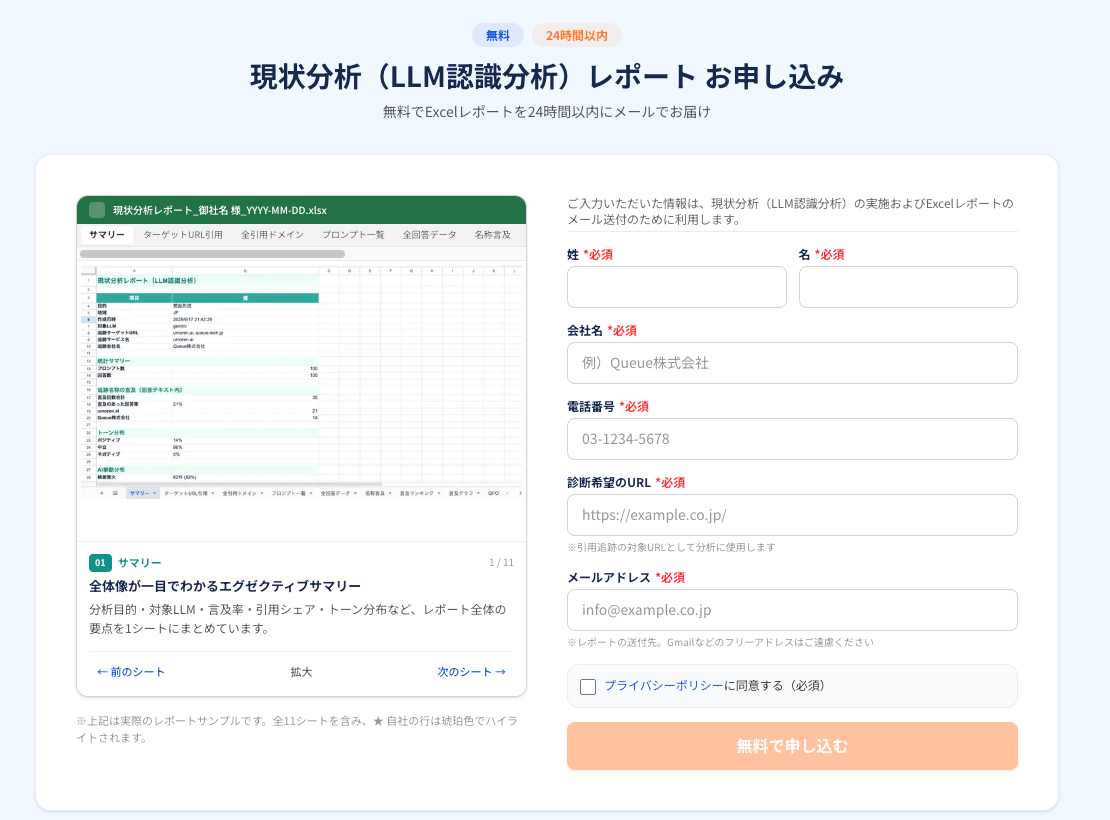
As a starting point to confirm at which stage your company's site is currently stopping, you can also grasp the current situation with a free diagnosis from umoren.ai.
Practical Articles to Read After Understanding the Mechanism of AI Search
Even if you understand the process flow of AI search, what to actually prepare is a separate decision. From the following articles, you can check how to design citations for your company's site and incorporate them into operations.
-
Practical Guide to Integrating LLMO and Content Marketing | Designing Sites That Are Cited with SEO×AI Optimization: Design method to increase AI citations by integrating SEO and LLMO
-
How Should Owned Media Change in the AI Search Era? Design Strategy and Practical Guide That Does Not Rely on PV: Design method for owned media cited in AI search
-
What Companies with Few Branded Searches Should Do First with LLMO | Practical Steps for Structuring Primary Information Cited in AI Search: Priority for companies with few branded searches to start with LLMO
-
What Is the Content Strategy for Health Apps to Be Cited in AI Search? Differences from SEO and Countermeasures: Information design method for health apps cited in AI search
-
Practical Guide to Preventing Corporate Reputation Damage with AIO Measures | Reverse AI Search Countermeasures and Establishing Reliable Information Sources: Steps to establish information sources to suppress corporate misrecognition with AIO