

We compare the attributes, purposes, and question differences of people using ChatGPT and Gemini for information search based on survey data. We have organized the differences in search behavior from prompt trends and the criteria for specific usage in business.
Many companies might feel unsure about which users are using ChatGPT and Gemini for work and information gathering, and for what purposes they are being differentiated.
In conclusion, public surveys show differences in the usage rates and age groups of ChatGPT and Gemini. Additionally, a study by Queue Corporation,which analyzed 35,482 prompts, confirmed differences in the number of searches conducted by the AI behind the questions.
However, the subjects measured in surveys and prompt analyses are different.
Understanding the differences between ChatGPT and Gemini involves separating "who is using them" and "how the AI is searching".
Companies need to consider AI search strategies (LLMO, AIO, AISEO, GEO) based on these user behaviors and AI search behaviors.
This article organizes the following about ChatGPT and Gemini:
-
Differences in usage rates, frequency, and user attributes
-
Purposes of use in information search, work, learning, and daily life
-
Trends in questions and prompts
-
Differences in search behavior occurring on the AI side
-
How to read survey data
-
Relation to corporate LLMO strategies
-
Differences between LLMO and SEO, AIO, GEO
-
Five points to determine if LLMO is necessary
-
KPI and basic approach for LLMO
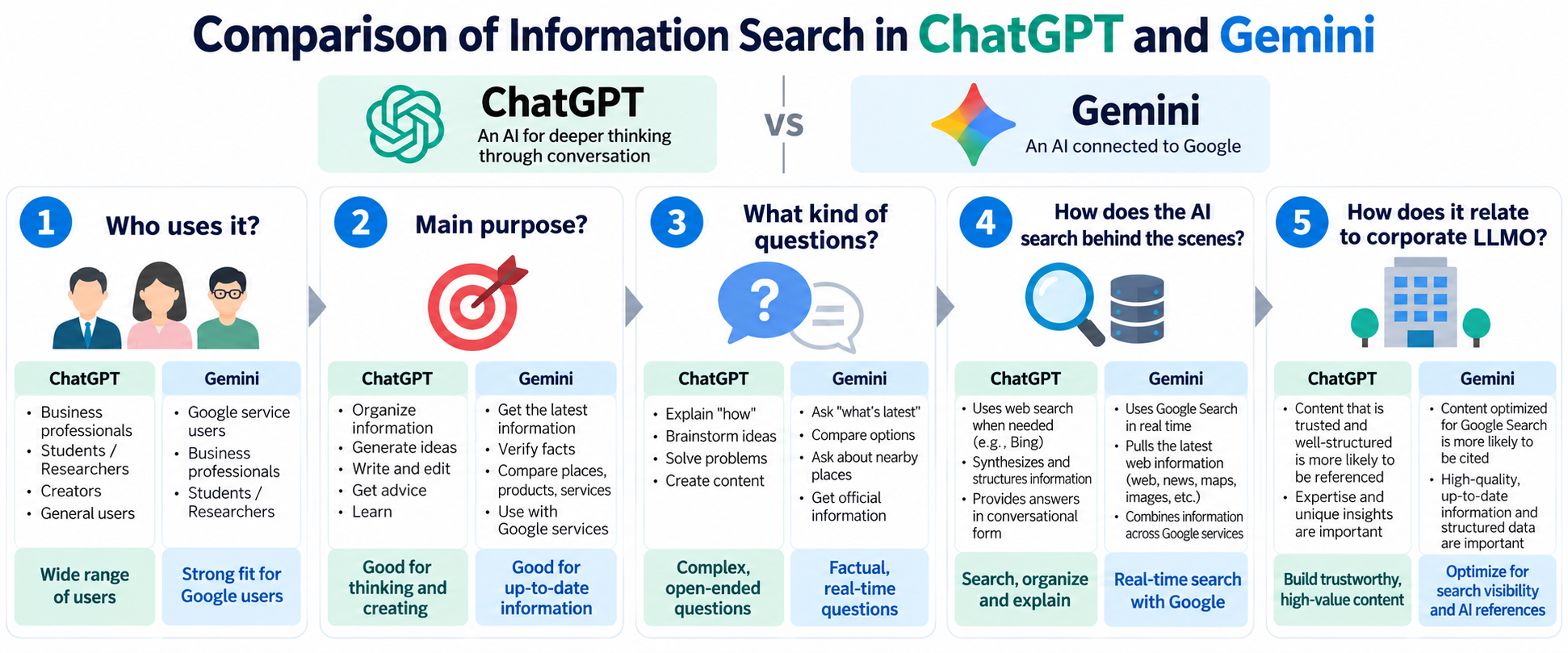
What are the criteria for evaluating the differences in people using ChatGPT and Gemini for information search?
When looking at the differences between ChatGPT and Gemini, it is not enough to simply consider "which has more users".
Who is asking what kind of questions, for what purpose, and how the AI is searching for information in response to those questions. By separating these four points, it becomes easier to organize the characteristics of both.
This article mainly compares from the following perspectives:
|
Perspective |
Content to confirm |
|
User attributes |
What kind of users, such as age groups, are using it |
|
Usage scenarios |
Where it is used, such as work, learning, and daily information gathering |
|
Purpose of use |
What they are seeking, such as understanding causes and mechanisms, collecting the latest information |
|
Question content |
Whether the question includes background and conditions or is short and specific |
|
AI-side search |
To what extent the AI conducts searches behind the questions |
It is important not to simply line up numbers from different surveys.
What are the differences in user attributes between ChatGPT and Gemini?
Public surveys have confirmed differences in the main age groups for ChatGPT and Gemini.
A survey conducted by Knowledge Holdings targeting 305 men and women aged 20 to 59 yielded the following results:
-
ChatGPT: 32.4% in their 20s, the highest
-
Gemini: 32.2% in their 50s, the highest
However, this does not mean "ChatGPT is only used by young people" or "Gemini is for older people".
These numbers merely indicate which age group was the most frequent among users who most often used each service in this survey.
Moreover, there is limited public data directly comparing usage rates by occupation. Therefore, explanations like "engineers and planners use ChatGPT" need to be treated separately from facts that can be directly confirmed from public data and hypotheses about usage trends.
What are the differences in usage purposes between ChatGPT and Gemini?
Regarding usage purposes, ChatGPT is sometimes organized as being used to organize background and mechanisms, while Gemini is used to confirm the latest information and specific facts.
For example,
"Why did the competitor's sales increase? Organize the causes from perspectives such as market environment and pricing strategy."
This question requires considering multiple conditions.
On the other hand,
"What new service did the competitor announce this month?"
This question focuses on confirming the latest facts.
However, this does not completely divide the usage reality of both services. The same user may use ChatGPT and Gemini according to their purpose.
Check "Target, Timing, Sample Size, Definition" when reading survey data
When investigating the actual usage of AI, looking only at numbers can lead to misunderstandings.
For example, the survey by Knowledge Holdings measures "which AI users are using" through a questionnaire.
On the other hand, theQFO actual survey targeting 35,482 promptsby Queue Corporation analyzes how ChatGPT and Gemini search behind the questions.
In other words,
-
Questionnaire survey = How users are using it
-
Prompt analysis = How AI is acting on questions
These are not competing data but data capturing AI search from different perspectives.
Also, "usage share" and "usage rate" do not necessarily mean the same thing. It is important to check what kind of question text was used and who was calculated as the denominator.
Comparing the Attributes, Purposes, and Question Content of People Using ChatGPT and Gemini for Information Search
First, let's organize the representative data that is publicly available.
|
Comparison item |
ChatGPT |
Gemini |
|
Usage share (Knowledge Holdings survey, 305 people) |
47.5% |
29.5% |
|
Most common age group |
20s (32.4%) |
50s (32.2%) |
|
Percentage using daily |
49.0% |
47.8% |
|
Characteristics of usage reasons |
Ease of use, free range, quality of answers, etc. |
Ease of use, free range, search strength, etc. |
|
Main usage trends |
Organizing and delving into information including background and conditions |
Checking the latest information and specific details |
|
Average number of behind-the-scenes searches |
5.29 times |
3.34 times |
*Usage share, age group, usage reasons, daily usage rate are from the Knowledge Holdings survey of 305 people. The average number of behind-the-scenes searches is from Queue Corporation's analysis of 35,482 prompts. Each survey has different targets, timing, and indicators.
In the Knowledge Holdings survey, 45.8% of the 275 AI users surveyed used it "almost daily," and 36.4% used it "several times a week," totaling 82.2% who used it several times a week or more.
It is important to note that82.2% is the usage frequency of the entire AI user group surveyed, not that ChatGPT is 82.2% and Gemini is also 82.2%.
Also, the daily usage rate for ChatGPT was 49.0%, and for Gemini, it was 47.8%.
What are the Characteristics of the Attributes, Purposes, and Question Content of People Using ChatGPT for Information Search?
The usage share of ChatGPT is 47.5%, the highest value in the Knowledge Holdings survey.
In the same survey, 32.4% of ChatGPT users were in their 20s, the highest percentage.
However, this survey alone cannot conclude that "ChatGPT is an AI for young people." It is important to read it considering that it targets people aged 20 to 59 and does not directly measure attributes other than age.
What kind of users are using ChatGPT for search?
In the Knowledge Holdings survey, the following items were top reasons for choosing ChatGPT overall:
-
Easy to use: 50.2%
-
Wide range of free use: 42.6%
-
Fast responses: 40.0%
ChatGPT is sometimes introduced as being used for work and learning, where users explain the background of questions while seeking answers.
However, there is limited public data directly showing usage rates by occupation. Therefore, it is appropriate to perceive its use in specialized professions such as marketing, business planning, development, and research/analysis as a usage trend.
What are the purposes and question content for searching with ChatGPT?
ChatGPT is used not only to "find answers" but also for purposes of thinking based on the obtained information.
For example, here are some questions:
Work
"Investigate the background of the increase in churn rates in the domestic SaaS market and propose three measures our company should take."
Learning
"Explain the impact of rising interest rates on mortgage screening, starting from the mechanism."
Comparison
"Create a table comparing the pricing structures of Company A and Company B from the perspective of small and medium-sized enterprises."
In such questions, background, conditions, and constraints may be conveyed at once.
And, after receiving the question, the AI does not necessarily perform just one search. It may break down the question into multiple search queries, search each, and integrate the results.
This mechanism is called **QFO (Query Fan-out)**.
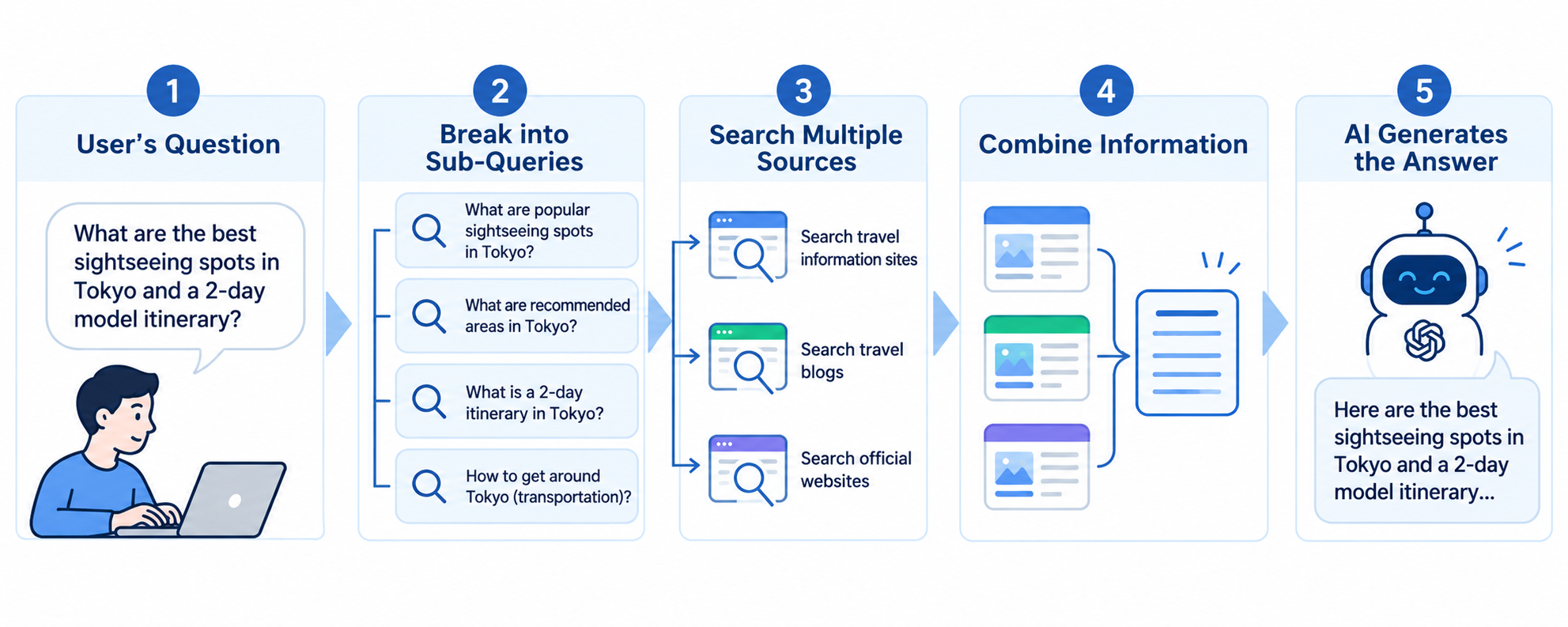
In Queue Corporation's analysis of 35,482 prompts, the average QFO number for ChatGPT was 5.29 times, and for Gemini, it was 3.34 times. 5.29÷3.34 = approximately 1.58, so the average QFO number for ChatGPT is about 1.58 times that of Gemini.
Furthermore, the same study found that the more detailed the prompt, the more the QFO number increases.
-
ChatGPT: Short text 4.51 times → Long text 9.03 times
-
Gemini: Short text 3.25 times → Long text 6.11 times
This result indicates thatthe more specific the conditions such as budget, region, and purpose are written in the question, the more likely multiple searches will occur on the AI side.
The process by which ChatGPT executes web searches and selects sources is explained in detail inChatGPT Search Behavior and Source Selection, and the reasons why different companies are introduced depending on the question are explained inDifferences in AI Answers by Question.
What are the Characteristics of the Attributes, Purposes, and Question Content of People Using Gemini for Information Search?
The usage share of Gemini is 29.5%, the second highest result in the Knowledge Holdings survey after ChatGPT.
In the same survey, 32.2% of Gemini users were in their 50s, the highest percentage.
Additionally, reasons for choosing Gemini include "strong search capabilities" and "integration with the Google ecosystem".
What kind of users are using Gemini for search?
In the Knowledge Holdings survey, Gemini users were most frequently in their 50s.
The company highlights "strong search capabilities" and integration with Google services as features of Gemini.
However, it is not appropriate to interpret this as "Gemini is only used by middle-aged and senior people".
In CyberAgent's August 2026 survey, the usage rate of generative AI for search was 52.3%, with ChatGPT at 30.6% and Gemini at 23.2%. The target was 9,278 people nationwide aged 15 to 69, including AI Mode.
Since the targets and definitions differ for each survey, these numbers cannot be simply compared with the Knowledge Holdings survey.
What are the purposes and question content for searching with Gemini?
Gemini is sometimes used for purposes such as confirming news, corporate announcements, and the latest statistics, which are information with up-to-date relevance.
For example,
Daily life
"Tell me a Japanese restaurant around Shibuya Station that can be reserved for tonight."
Work
"Summarize the news announced in the XX industry this week in three lines."
Fact-checking
"Organize the claims and evidence on this page."
These are the types of questions.
However, such usage is not limited to Gemini. ChatGPT can also search for the latest information, and Gemini can perform complex investigations and document creation.
Moreover, Deep Research is offered on both ChatGPT and Gemini. It is a function where AI plans a survey, investigates multiple pieces of information on the web, and summarizes it as a report.
When using AI's answers for fact-checking, it is important not to judge correctness based on the answer alone but to check the primary information cited. Especially, confirm the publication date, target period, and definition of numbers.
If you want to distinguish between the Gemini app and Google Search's AI features, refer toDifferences in Citation Sources of Gemini, AI Mode, and AI Overviews, which organizes the differences in reference sources for the same question.
How to Differentiate the Use of ChatGPT and Gemini in Information Search?
Instead of thinking about "which is better" between ChatGPT and Gemini,it is easier to understand in practice to differentiate based on the purpose of the question.
|
Scenario |
AI to start using |
Example question |
|
Planning and hypothesis creation |
ChatGPT |
"Organize the causes of market contraction into three hypotheses." |
|
Latest trends of competitors |
Gemini |
"Summarize the recent new service announcement of Company A." |
|
Learning and understanding mechanisms |
ChatGPT |
"Explain the mechanism by which generative AI creates answers in a diagrammatic way." |
|
Shopping, travel, and restaurant search |
Gemini |
"List five family-friendly accommodations in Kyoto." |
|
Information search within Gmail and Google Drive |
Gemini |
"List the amounts from last month's estimate emails." |
|
Creating document structures |
ChatGPT |
"Structure this survey result into a 10-page presentation for executives." |
However, this is not a fixed rule.
For example, after researching "latest trends of competitors" with ChatGPT, you can verify the latest information with Gemini.
It is also important to verify primary information rather than relying solely on AI responses for important numbers and company information.
The way to construct questions including purpose, assumptions, and comparison axes can be checked with specific examples inMeaning of AI Search Queries and How to Create Questions.
How Do the Differences in ChatGPT and Gemini's Usage Relate to Corporate LLMO Strategies?
As we have seen, there are differences in user attributes and usage trends between ChatGPT and Gemini.
Furthermore, Queue Corporation's prompt analysis has confirmed differences in the number of searches conducted by the AI behind the questions.
For companies, it is not only important to know "which has more users, ChatGPT or Gemini".
It is necessary to see how their products and services are treated as information when actually questioned by AI.
One of the initiatives to improve the exposure and treatment of company information in AI responses is LLMO.
What is the Purpose of LLM and LLMO Measures?
LLM stands for Large Language Model.
It is a core technology of AI that understands human input and generates text based on large amounts of text data. ChatGPT and Gemini are conversational services using LLM.
LLMO stands for Large Language Model Optimization.
In this article,LLMO is treated as an initiative aiming for a state where company information is accurately used in AI responses and included in comparison and recommendation candidates.
The state to be observed in LLMO is broadly divided into three categories.
|
State |
Meaning |
Specific example |
|
Citation |
Your company's page is shown as a source in AI responses |
Your company's article appears in the reference links of the response |
|
Mention |
Your company name appears in the response text |
"Company A is a representative company" is written |
|
Recommendation |
Your company is listed as a recommendation |
"Company A is suitable for small businesses" is written |
In other words, the purpose of LLMO is not simply to display your company name in AI.
It is important to create a state where accurate information about your company is referenced and mentioned and recommended in a contextually appropriate manner.
If you want to organize terms such as LLMO, RAG, and QFO, refer toEssential Terms for AI Search Strategies and LLMO Basics, which summarizes their roles and relationships with SEO.
What Information Structures Are Related to AI Search?
In AI search, there may be mechanisms that search external information and generate responses based on the results.
One such mechanism is RAG (Retrieval-Augmented Generation).
Queue Corporation explains that AI search strategies are designed by reverse-engineering from mechanisms such as RAG, Embedding, Tokenizer, and response generation.
However, since the internal processes of AI search differ by service, not all AI searches can be treated as a single mechanism.
On the company side, the starting point is to first confirm whether your company's information can be accurately and consistently verified on the web and then actually investigate how it is treated by AI.
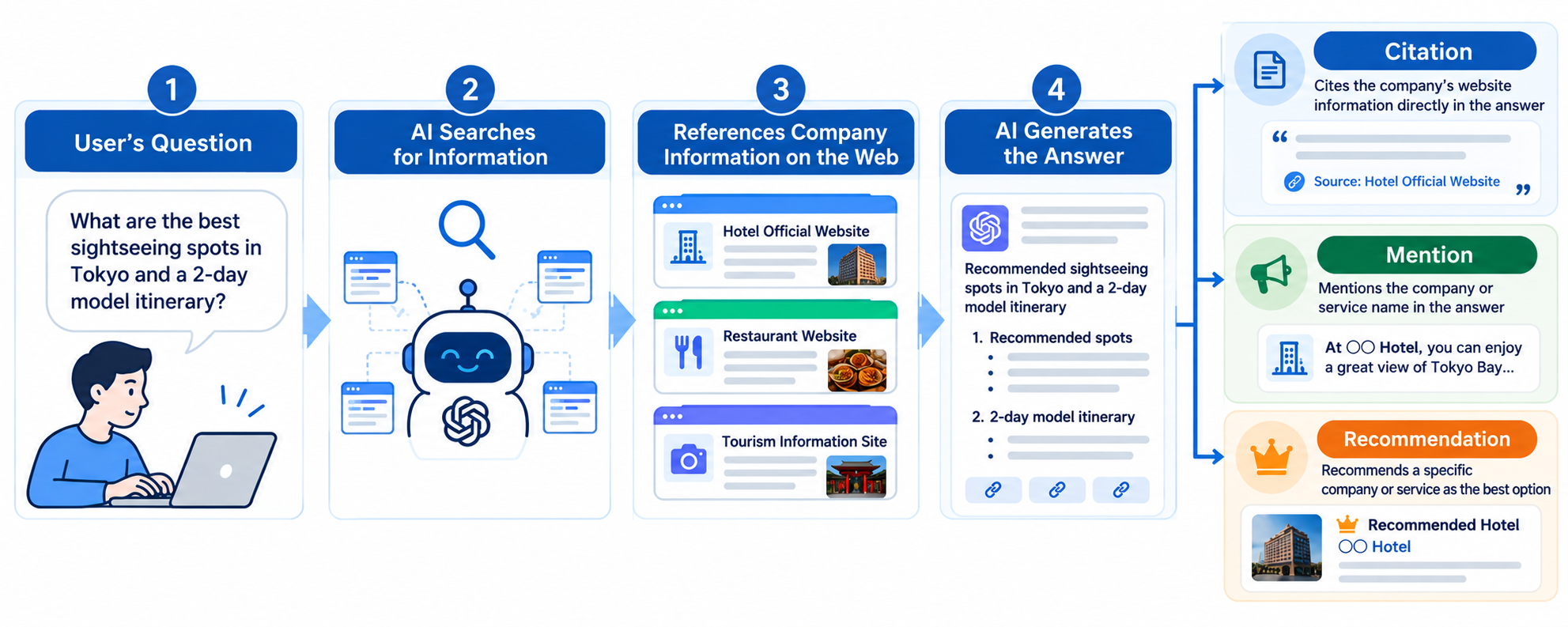
The approach to confirm at which stage your company's page is excluded from reference candidates, from obtaining external information to generating responses and citations, is explained in detail inThe Relationship Between RAG and AI Search, and the Mechanism Leading to Citation.
How Do LLMO and SEO, AIO, GEO Differ?
Both LLMO and SEO are measures to make company information discoverable, but the main places where they are evaluated differ.
|
Measure |
Meaning |
Main target |
|
SEO |
Search Engine Optimization |
Search results on Google Search, etc. |
|
AIO |
AI Optimization |
Overall search and response experience using AI |
|
GEO |
Generative Engine Optimization |
Overall responses by generative AI |
|
LLMO |
Large Language Model Optimization |
Responses using LLM such as ChatGPT and Gemini |
*Terms related to AI search may be defined differently by companies and media. This article explains them based on the above practical organization. AI summary display in Google Search is treated separately from Google's "AI Overviews".
It becomes easier to understand if you think of SEO as targeting discovery in search results and LLMO as targeting information use in AI responses.
They are not conflicting measures.
SEO measures that organize information on the website can sometimes become the foundation for AI to understand and reference information. On top of that, it is necessary to confirm citations, mentions, and recommendations in AI search.
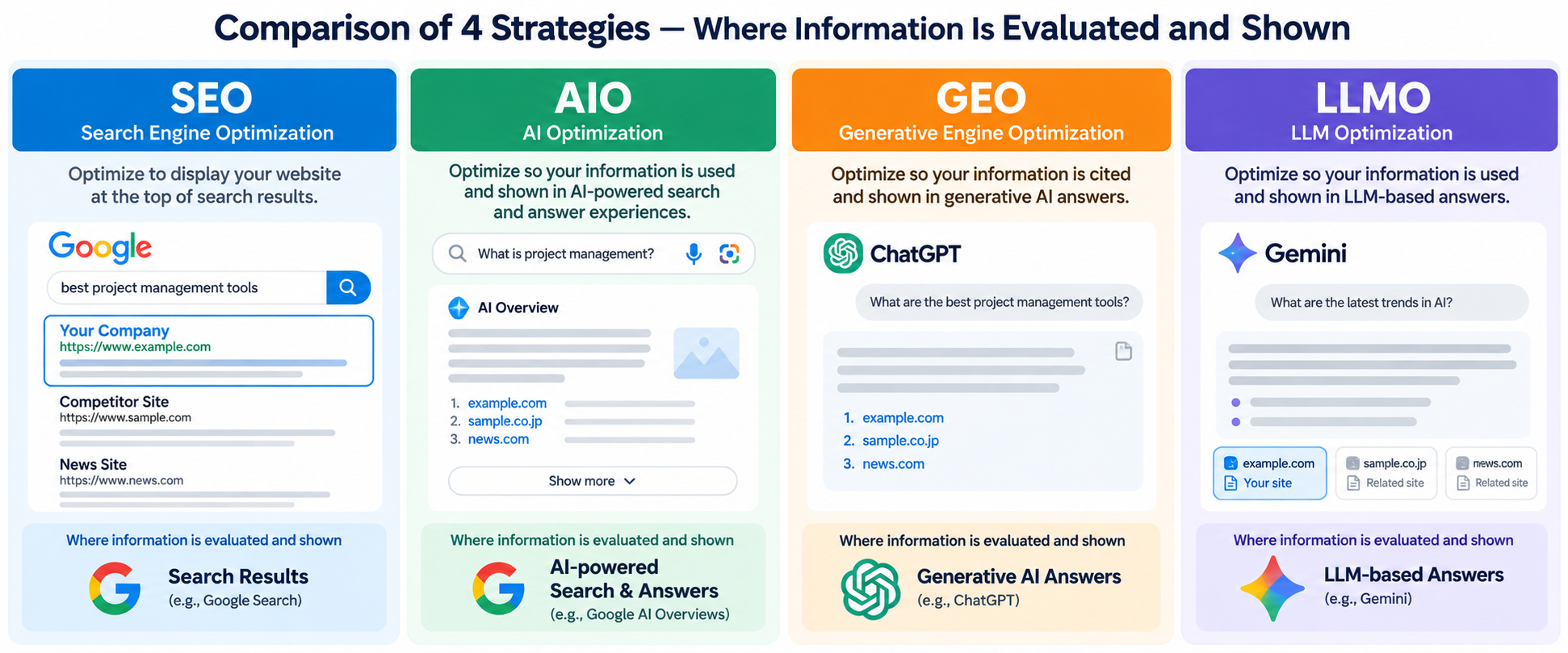
Alternative text: Diagram comparing the target ranges and differences of SEO, AIO, GEO, and LLMO
Which Companies Need LLMO, and What Are the Five Points to Determine Priority?
Not all companies need to work on LLMO with the same priority.
Especially for products that may be compared or recommended by AI, it is significant to confirm how your company is treated.
First, check the following five items:
-
When asking about your company name in ChatGPT or Gemini, is it explained correctly?
-
When asked, "Which company is recommended for XX?", is your company included as a candidate?
-
Is it not the case that only competitors are compared and recommended by AI?
-
Is AI not introducing your company with outdated pricing or service content?
-
Even though you rank high on Google Search, is the number of inquiries via AI not increasing?
If there are issues with multiple of the five items, start by investigating how your company is viewed by AI.
From the perspective of product characteristics, it can be organized as follows:
|
Category |
Examples of companies and products |
|
Easy to consider necessity |
B2B SaaS and support services, housing and construction, high-priced products with long consideration periods, products listed on comparison sites |
|
Want to carefully determine priority |
Products where transactions are completed by referrals or local reviews, low-priced items purchased without consideration, contracted work with fixed clients |
However, this is not something to be judged solely by industry.
It is important to actually ask AI about your company's products and services and confirm what kind of answers are given.
When investigating missing information on your website, refer toQFO Analysis Examples and Four Limitations, which organizes the range that can estimate the points AI seeks and the points that cannot guarantee citation acquisition.
What KPIs Measure LLMO?
In LLMO, it is easier to grasp the situation by not only looking at "whether it was displayed in AI" but also measuring how it was displayed separately.
|
KPI |
Meaning |
|
Citation rate |
The proportion of questions for which your company's page was included as a source |
|
Mention rate |
The proportion of questions for which your company name appeared in the response text |
|
Recommendation rate |
The proportion of questions for which your company was listed as a recommendation |
|
Number of visits via AI |
The number of people who visited your website from AI responses |
|
Number of conversions via AI |
The number of conversions generated from AI responses |
Here,it is also important to manage CV (conversion) and CVR (conversion rate) separately.
Also, since ChatGPT and Gemini have different responses and search behaviors, if possible, aggregate them by AI.
The idea of evaluating not only exposure in AI responses but also inquiries and contracts after visits is explained inInquiry Routes and KPI Design in the AI Search Era.
What Order Should LLMO Be Advanced?
LLMO is not a measure that ends once content is created.
Basically,
Diagnosis → Design → Improvement → Monitoring
is an easy way to organize the flow.
|
Stage |
What to do |
|
Diagnosis |
Check how your company is treated in ChatGPT and Gemini |
|
Design |
Decide which questions, users, and products to prioritize |
|
Improvement |
Improve websites, content, and information structures |
|
Monitoring |
Continuously check citation rate, mention rate, recommendation rate, etc. |
Since AI search responses and reference information change, it is important to continuously check the state rather than ending after one improvement.
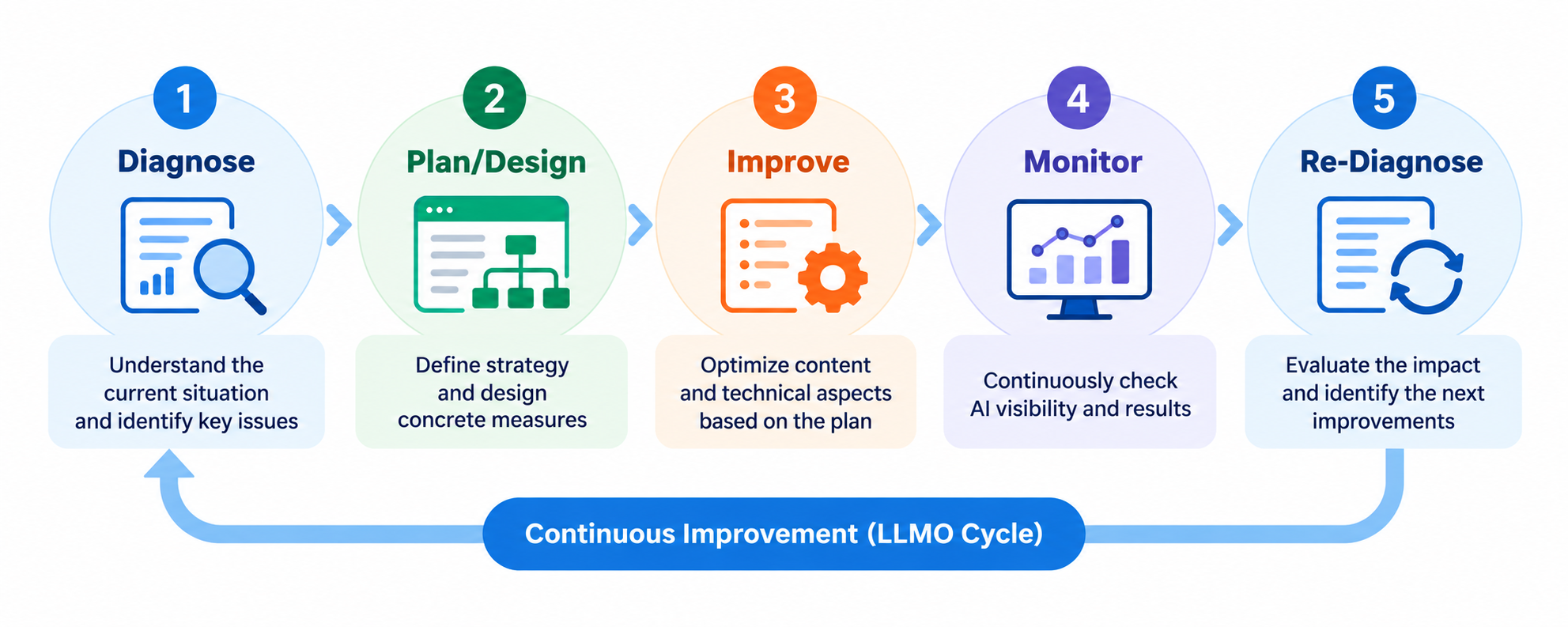
The procedure to incorporate this flow into daily article production and improvement of existing pages can be checked inPractical Guide to Integrating LLMO and Content Marketing.
Companies and Services Related to the Use of ChatGPT and Gemini for Information Search
When investigating the actual usage and search behavior of ChatGPT and Gemini, there are companies that publish surveys and companies that publish information on how to utilize both services.
Here, we organize the published information and service content of each.
Queue Corporation

Queue Corporation provides analysis and support for AI search strategies through umoren.ai.
In the analysis of 35,482 prompts, they compared the QFO numbers of ChatGPT and Gemini, revealing a difference of ChatGPT averaging 5.29 times and Gemini averaging 3.34 times.
Their main service, Umoren.ai, offers AI search exposure diagnosis, LLMO strategy design, content and structure improvement support, and continuous analysis and improvement.
They also offer a free diagnostic tool for AI search strategies called "AI SEO Score".
Knowledge Holdings Corporation
Knowledge Holdings Corporation has published a survey on the actual usage of AI services targeting 305 men and women aged 20 to 59.
The survey organizes the usage share, frequency, reasons for being chosen, and age groups of ChatGPT and Gemini.
They also provide cross-measures for SEO, MEO, LLMO, and SNS, and support using the "AXiY System".
Den-San System Corporation

Den-San System Corporation provides support for the introduction of Google services and hands-on training.
They also publish information comparing Gemini and ChatGPT from multiple perspectives, which is useful for companies using Google Workspace considering the use of generative AI.
R-Stone Corporation
R-Stone Corporation is a recruitment agency specializing in engineers and creators in the IT, web, and gaming industries.
They also publish articles comparing the three generative AIs, ChatGPT, Gemini, and Claude, by usage.
This is useful for checking how to differentiate the use of generative AI from the perspective of engineers and creators.
Frequently Asked Questions About the Use of ChatGPT and Gemini for Information Search
What are the differences in users using ChatGPT and Gemini for information search?
In the Knowledge Holdings survey of 305 people, 32.4% of ChatGPT users were in their 20s, and 32.2% of Gemini users were in their 50s, each being the highest.
However, this is the age distribution in one survey and not a fixed attribute applicable to all users.
How do the search purposes and question content differ between ChatGPT and Gemini?
Public information sometimes organizes ChatGPT as being used for organizing and delving into information including background and conditions, while Gemini is used for confirming the latest information and specific facts.
However, both services support a wide range of uses and are not clearly differentiated.
Are there differences in AI-side search behavior between ChatGPT and Gemini?
Yes, there are.
Queue Corporation analyzed 35,482 prompts and found that the average QFO number was 5.29 times for ChatGPT and 3.34 times for Gemini.
Simple calculations show that ChatGPT is about 1.58 times that of Gemini.
Furthermore, it has been confirmed that the more detailed the prompt, the more the QFO number increases.
Do engineers and planners often use ChatGPT?
There is limited public data directly comparing usage rates by occupation.
Therefore, rather than concluding "engineers and planners use ChatGPT," it is appropriate to perceive it as a usage trend where detailed conditions are specified and delved into, which is sometimes linked to ChatGPT's usage trend.
Which should I use for daily information gathering or mobile searches?
For purposes such as daily information gathering, news checking, shopping, and travel, where specific information is sought, Gemini may be used.
However, similar searches can also be performed with ChatGPT.
Therefore, rather than "which should be used," it is basic to choose based on the purpose of the question and your usage environment.
Is Deep Research available on both ChatGPT and Gemini?
Deep Research is available on both ChatGPT and Gemini.
Both provide a function where AI plans a survey, investigates multiple pieces of information, and summarizes it as a report.
Is there a benefit to using both ChatGPT and Gemini?
Yes, there is.
For example, you can organize hypotheses and points with ChatGPT and confirm the latest information with Gemini.
For important information, it is crucial to ultimately confirm primary information regardless of which AI is used.
How can I check how my company is treated in ChatGPT and Gemini?
First, create multiple questions that actual customers are likely to search for, such as your company name, product/service name, comparison with competitors, and recommendations within the category.
Then, input the same questions into ChatGPT and Gemini,
-
Check if your company is explained correctly
-
Check if your company is mentioned
-
Check if your company page is cited
-
Check if your company is recommended
-
Check if pricing and service content are outdated
By conducting such checks regularly, you can grasp how your company is viewed in AI searches.
How should I compare the costs and support content of AI search strategies?
When comparing support companies, do not just look at the price, but also confirm,
-
What is diagnosed
-
Which AI is targeted
-
Whether it handles not only content but also information structures
-
Whether citation rate, mention rate, recommendation rate, etc., can be measured
-
Whether continuous monitoring and improvement are performed
By confirming these, it becomes easier to judge whether it matches your company's purpose.
When comparing what can be requested in terms of diagnosis, strategy design, content improvement, and continuous measurement, refer toAI Search Strategy Consulting Support Content and How to Choose a Company.
Conclusion: Understand the Differences in ChatGPT and Gemini's Usage for Information Search and Apply Them to Your Work
When looking at the differences between ChatGPT and Gemini, it is important to consider not only usage share but alsouser attributes, usage purposes, question content, and AI-side search behavior separately.
In the Knowledge Holdings survey of 305 people, ChatGPT's usage share was 47.5%, and Gemini's was 29.5%. The most common age group was 20s for ChatGPT and 50s for Gemini.
On the other hand, Queue Corporation's analysis of 35,482 prompts showed that the average QFO number on the AI side was 5.29 times for ChatGPT and 3.34 times for Gemini.
To summarize the points of this article:
-
There are differences in usage share and age groups between ChatGPT and Gemini
-
ChatGPT tends to be used for organizing and delving into information including background and conditions
-
Gemini is sometimes used for confirming the latest information and specific facts
-
There are also differences in QFO numbers on the AI side between ChatGPT and Gemini
-
Survey and prompt analysis measure different subjects
-
It is necessary to confirm important numbers, survey targets, sample size, timing, and definitions
-
It is important for companies to confirm how they are treated in both ChatGPT and Gemini
-
LLMO can separate and grasp the state of citation, mention, and recommendation
-
LLMO proceeds in a cycle of diagnosis, design, improvement, and monitoring
Especially for companies responsible for marketing or SEO and LLMO, it is important not only to look at "which is more popular, ChatGPT or Gemini," but also to confirmwhat kind of questions your customers are asking AI and how AI is treating your company in response to those questions, which leads to the next analysis.
First, search for your company name or product/service name on both ChatGPT and Gemini and compare the state of citation, mention, and recommendation to easily grasp how your company is viewed in AI search.
Queue Corporation supports everything from current situation analysis to strategy design, content production, and continuous improvement, and the specific support range can be checked inAI Search Consulting and Umoren.ai Service Introduction.
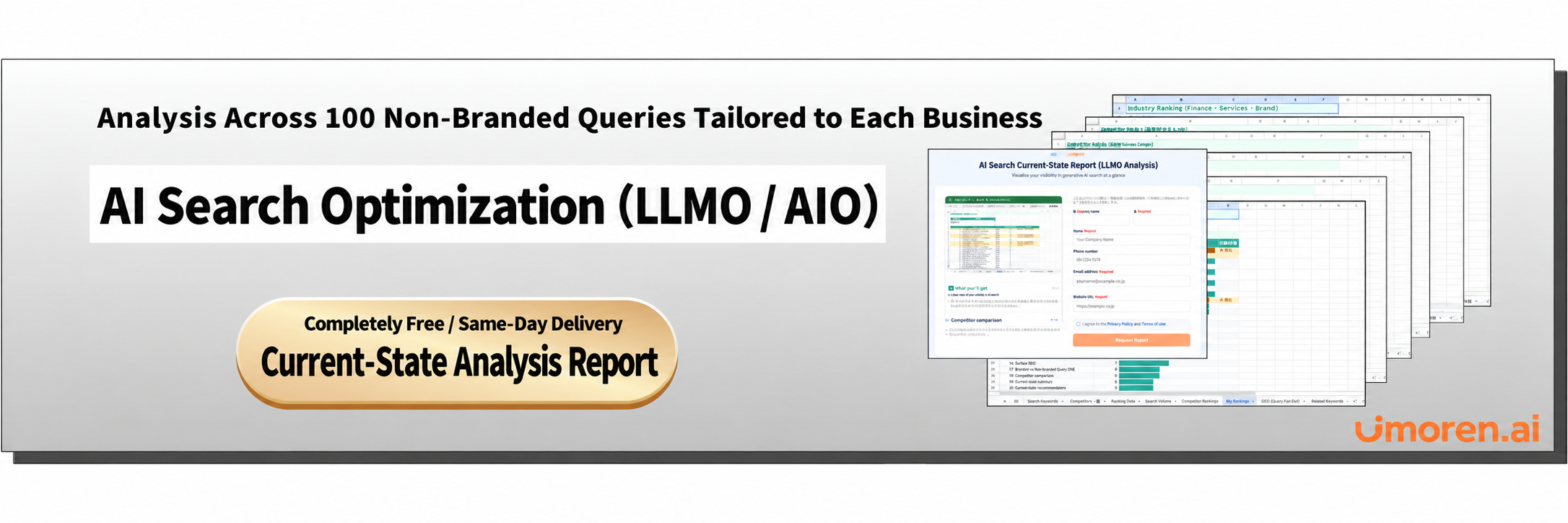
We’ll start by providing you with a free current-state analysis!
100 Prompts · Free · Same-Day Delivery · Fully Personalized