

What distinguishes AI agents from regular chat AI? From the control loop mechanism of planning towards goals, using external tools, and verifying execution results, we explain the essential differences between the two and points to consider when implementing them.
The term AI agent is being heard more frequently, but it can be difficult to understand how it differs from regular chat AI and what tasks it is suited for. While both use LLMs, the way they operate to reach goals differs.
Regular chat AI generates responses to inputs, while AI agents repeatedly plan, execute, observe, and re-plan towards a goal.
In this article, we refer to the interactive use of returning responses to a single instruction as "regular chat AI." We will then explain the structure of AI agents, the mechanism connecting planning, tool usage, and verification of execution results, the roles of LLM and RAG, and points to consider when implementing them.
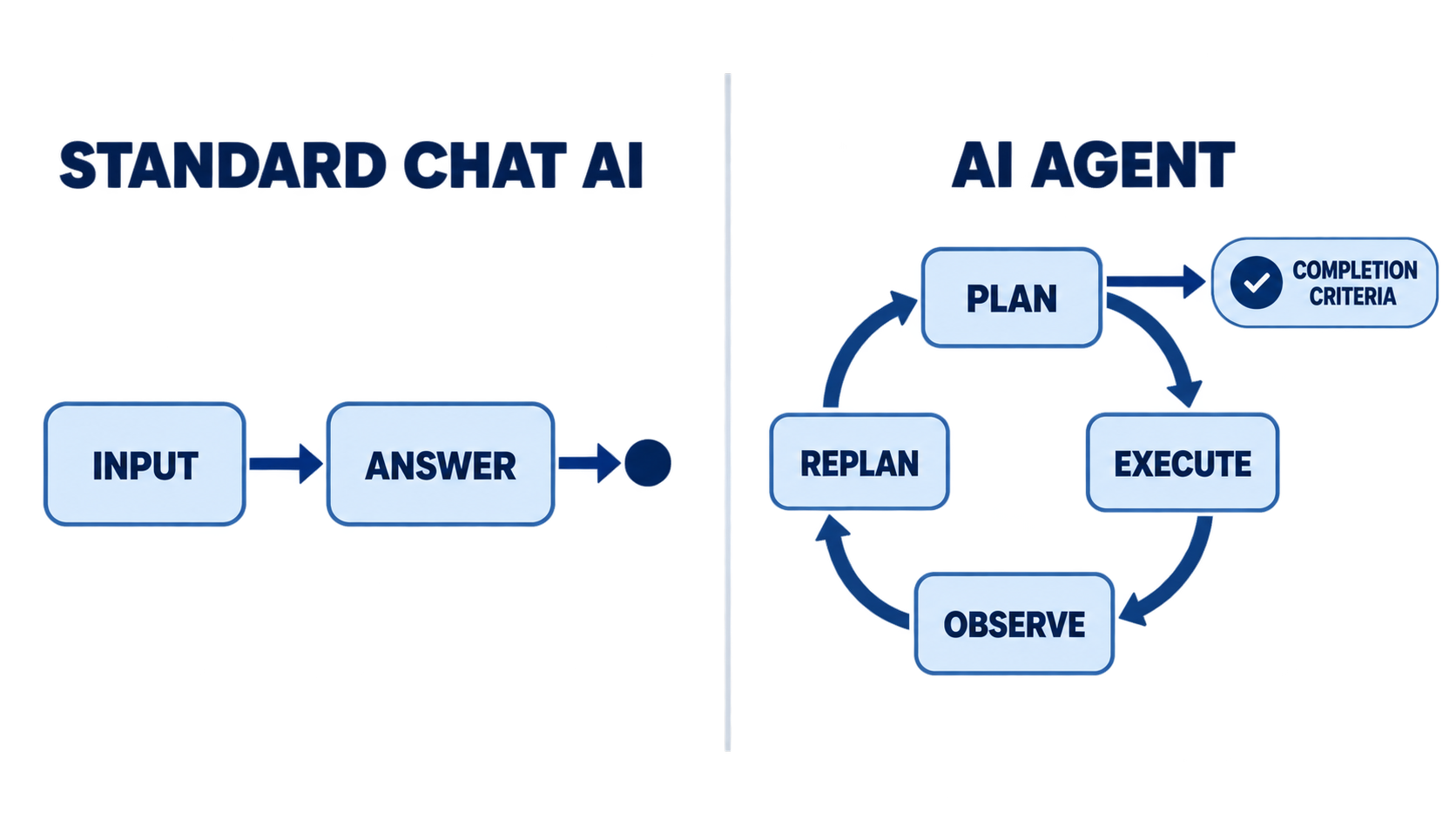
For example, in a request to "research and compile a comparison table of pricing pages of three competitors," regular chat AI outputs the form of a comparison table from its learned knowledge. AI agents determine the research targets and retrieve each company's page using search tools. If a page cannot be retrieved, they try other means and finally generate the comparison table. Even with the same request, the scope of action and the nature of the deliverables differ.
Differences Between Regular Chat AI and AI Agents
AI agents are systems that plan for goals given by humans, execute external tools, and decide the next action while verifying the results. While regular chat AI completes in a single input-output cycle, AI agents repeat multiple steps until the completion conditions are met.
AI agents
AI agents are systems that repeat planning, tool execution, observation, and re-planning towards goal achievement.
Response Mechanism and Execution Mechanism
Regular chat AI can be described as a "passive output device," while AI agents are "active execution entities." In the former, humans decide the next operation. In the latter, the system chooses the next action based on observed results.
|
Comparison Axis |
Regular Chat AI |
AI Agent |
|---|---|---|
|
Input Unit |
Single question/instruction |
Goal to be achieved |
|
Internal Processing |
Prompt→Token Generation→Output |
Planning→Tool Execution→Observation→Re-planning Loop |
|
External Interaction |
None in principle (text output only) |
Calls search APIs, databases, CRM, etc. |
|
When Failing |
Human re-instructs |
Identifies cause and retries by changing means |
|
State Retention |
Within conversation history |
Retains task progress and intermediate deliverables |
|
Completion Criteria |
Upon returning a single response |
Upon satisfying completion conditions or triggering stop conditions |
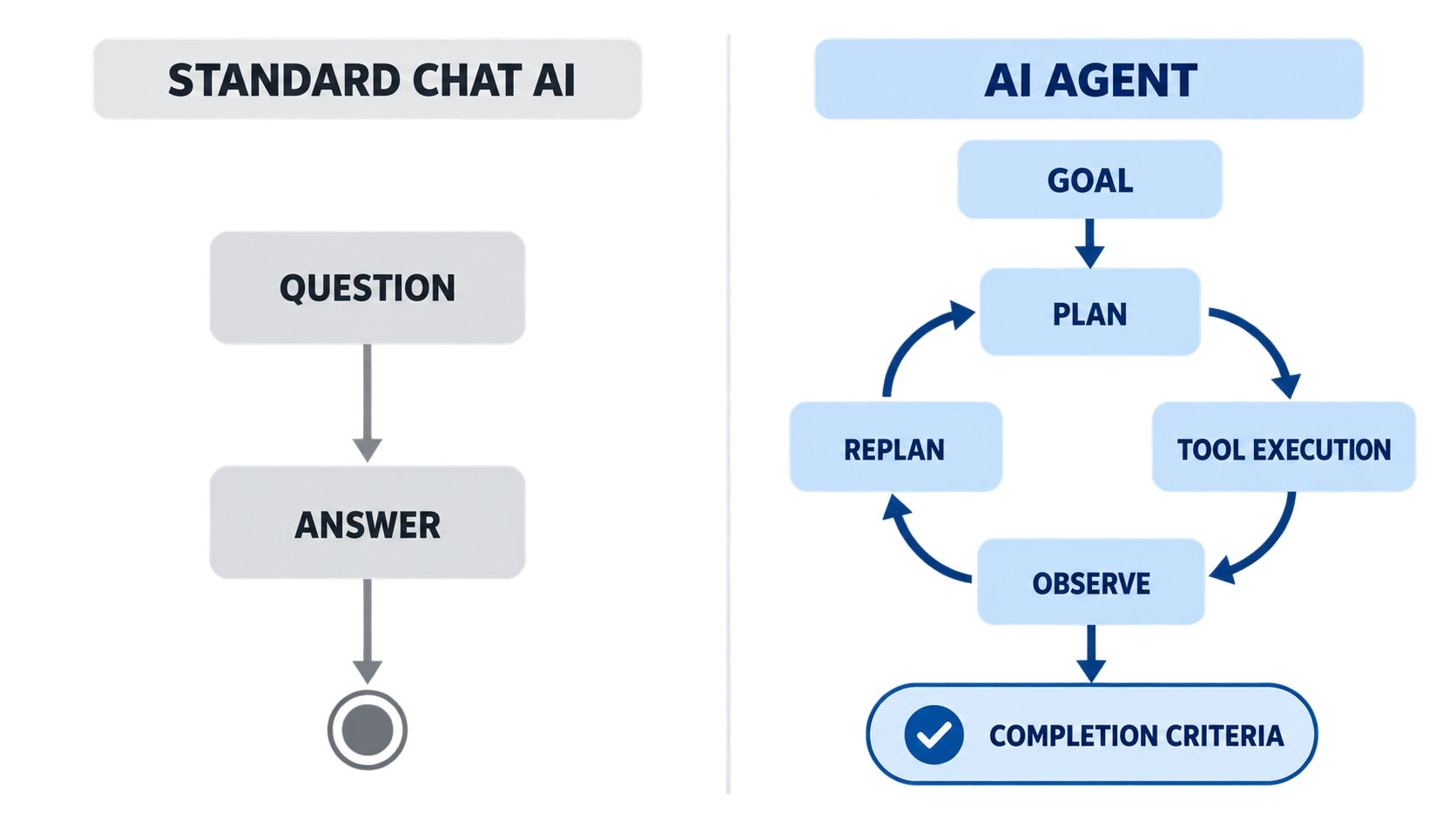
"Token" refers to the smallest unit of string when AI processes text. Regular chat AI predicts tokens sequentially to complete a single response and finishes processing.
Differences from High-Performance Chatbots
The difference between AI agents and chatbots lies not only in model performance but also in system structure. Even with the same LLM, without a loop to connect with external tools and receive execution results, it cannot function as an agent.
The structural differences can be organized into the following five points:
-
Autonomy: Whether humans instruct the next action or the system decides
-
Goal Orientation: Whether the purpose is a single response or goal achievement
-
Interaction with Environment: Whether it only returns text or executes APIs to change states
-
State Persistence: Whether it disappears after the conversation or retains task progress
-
Stop Conditions: Whether it ends with response generation or needs defined conditions to stop
If stop conditions are not designed, the agent may repeat the same process.
Roles of LLM and Agent Platform
LLM (Large Language Model) acts as the brain for judgment, while the agent platform connects that judgment to execution and controls the loop. LLM alone cannot acquire external information or operate business systems.
LLM
LLM interprets goals and results, while the agent platform handles tool execution, history management, and loop control.
-
LLM's Role: Interpreting goals, proposing task decomposition, deciding tools and arguments, interpreting execution results
-
Agent Platform's Role: Calling tools, returning results, managing history and intermediate deliverables, controlling and stopping loops
Differences Between RAG and AI Agents
RAG (Retrieval-Augmented Generation) is a mechanism that searches for external information and generates responses based on that information. While RAG is a technology to supplement the basis of responses, AI agents aim to achieve goals by using multiple tools, including RAG.
RAG , AI agents
RAG is a mechanism that uses searched information as the basis for responses, and in AI agents, it is one of the components used for goal achievement.
-
RAG: The flow of search→acquisition→generation is typically one-time, with the purpose of improving response accuracy
-
AI Agent: Search is one means, evaluating acquisition results, and switching to re-search or other tools if insufficient
-
Relationship Between the Two: RAG often operates as a component within AI agents
The flow from information acquisition to response generation is explained in detail inthe explanation of the relationship between RAG and AI search andthe diagram of AI search processing flow.
Connection of Planning, Tool Usage, and Verification of Execution Results
Planning, tool usage, and verification of execution results are not independent processes. They form a single control loop of "Planning→Execution→Observation→Re-planning." If the observation results do not meet the completion conditions, the process returns to planning to choose another means.
In this article, we divide the operation of AI agents into the following four parts according to the actual processing order:
-
Planning
-
Tool Use
-
Verification of Execution Results (Observation / Reflection)
-
Re-planning and Stop Conditions
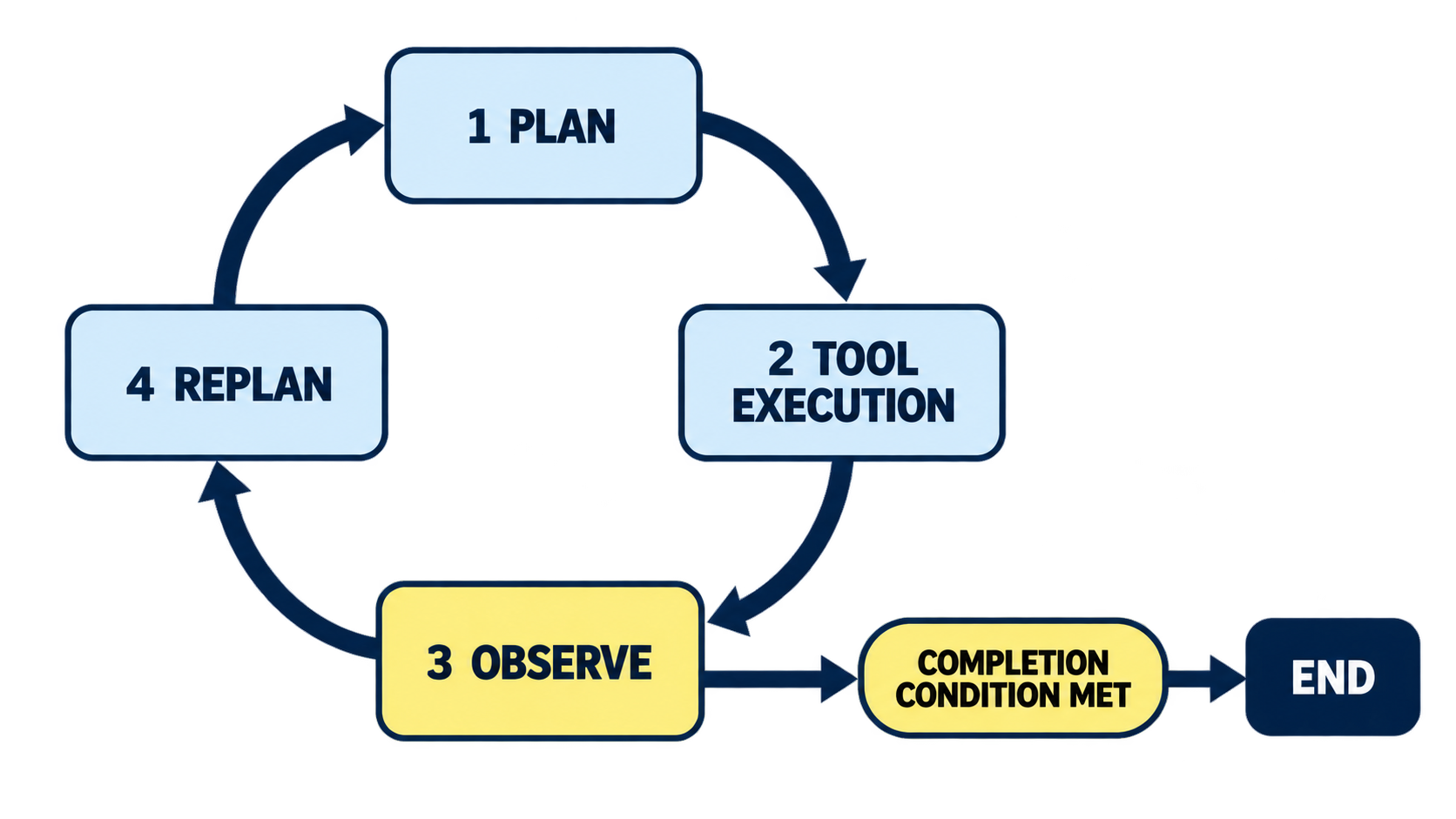
Deciding Completion Conditions and Execution Order in Planning
Planning involves breaking down a large goal into executable tasks and deciding the execution order. Without defining completion conditions here, it cannot be judged in later observations whether the goal has been achieved.
At Queue Corporation, goals are organized into "completion conditions, constraints, and necessary information," and execution order is determined based on dependencies and priorities. For example, in market research, the research targets and evaluation criteria are confirmed first, followed by information gathering, analysis, verification, and report creation.
-
Completion Conditions: What must be in place to consider the goal achieved. For example, a comparison table with pricing and service formats for three companies filled in
-
Constraints: Allowed information sources, cost limits, and the range of permissible operations
-
Necessary Information: A list of information lacking for goal achievement
-
Execution Order: Dependencies and priorities based on whether subsequent tasks require previous results
Calling External Information and Functions with Tool Use
Tool use involves selecting and calling external functions to execute each step of the plan. LLM outputs function names and arguments, and the agent platform performs the actual processing.
In Function Calling, AI returns structured data indicating "which tool to execute with which arguments." The application side executes the API. This separation allows for permission checks and human approval before execution.
Function Calling
Function Calling is a mechanism where AI returns tool names and arguments in a structured manner, and the application executes processing according to that content.
Queue Corporation compares connection destinations based on six perspectives in addition to tool function definitions.
For the latest information, search APIs are used; for internal information, databases are chosen; for customer interactions, CRM is selected, and the acquisition results are returned to LLM for the next decision.
|
Perspective |
Judgment Content |
Example |
|---|---|---|
|
Fit to Purpose |
Whether the tool brings closer to the goal |
Internal order records cannot be obtained with search APIs |
|
Data Freshness |
Whether the information is current |
Same-day stock cannot be answered with learned knowledge |
|
Accuracy |
Reliability of return values |
Prioritize primary information databases |
|
Processing Speed |
Time taken for response |
Execute large acquisitions in batches |
|
Cost |
API billing and token consumption |
Avoid duplicate acquisition of the same data |
|
Permission |
Whether the operation is authorized |
Require approval for write operations |
Evaluating Achievement in Verification of Execution Results
Verification of execution results involves observing tool return values and errors and comparing them with the completion conditions defined during planning. Without this step, AI cannot distinguish between "executing a process" and "achieving a goal."
At Queue Corporation, return values, statuses, and execution logs are observed to evaluate goal achievement. For example, in data registration, completion is not assumed with only a successful API response. Post-registration data is re-acquired, and mandatory items and content are verified. If conditions are not met, the cause is identified, corrected, and re-executed.
Execution Example of Control Loop
Below is an example of executing the task "register a new business partner in the customer master."
After an error due to missing contact name, the source was changed to the estimate and retried.
[1] Planning: Completion condition=customer ID issued, company name, address, and contact registered
Steps=(1) Duplicate check (2) Execute registration API (3) Re-acquire and verify registration details
[2] Tool: search_customer(name="○○商事") → 0 matches
[3] Observation: No duplicates. Determined to proceed to step (2)
[4] Tool: create_customer(name="○○商事", address="...", contact=null)
[5] Observation: HTTP 400 / error="contact is required"
[6] Re-planning: Contact name not acquired. Changed source to estimate PDF and added a step
[7] Tool: extract_document(file="mitsumori.pdf", field="contact") → "Tanaka"
[8] Tool: create_customer(..., contact="Tanaka") → HTTP 201 / id=10482
[9] Observation: Received successful response. Verification executed as completion condition not confirmed
[10] Tool: get_customer(id=10482) → All company name, address, and contact registered
[11] Judgment: Completion condition satisfied. Loop ends
Noteworthy points are [5] and [9]. In [5], it does not stop at the error but changes the source of missing information and revises the plan. In [9], it does not end with a successful response but re-acquires registration data and compares it with the completion conditions. These two behaviors are structural differences from single-response generation.
The loop alternating between reasoning and action is called "ReAct (Reasoning and Acting)." The design of verbalizing the cause of failure and reflecting it in the next attempt is known as "Reflexion (Self-correction)."
Ending the Loop Safely with Stop Conditions
Stop conditions are the criteria for ending the loop of an agent. Without its own criteria to stop, an agent will continue to operate, so it is necessary to decide the end conditions at the design stage.
-
Successful Stop: Ends when completion conditions are met
-
Trial Limit: Cut off retries of the same task at a certain number
-
Cost Limit: Ends when token consumption or API billing exceeds the threshold
-
Handover to Human: Stops processing and requests confirmation when judgment is uncertain
Points to Consider and Limitations When Introducing AI Agents
AI agents operate external systems, so incorrect execution can directly affect data and costs. When introducing them, it is necessary to first design the scope of permissions, stop conditions, and human approval points.
Security and Privacy Measures
The basic approach is to limit the permissions given to the agent and restrict executable operations. The range of connected tools directly translates to the range of operations the agent can execute.
-
Separation of Reading and Writing: Separate permissions for reference and update systems, requiring approval for update systems
-
Data Export Range: Design not to pass customer or personal information to external APIs
-
Prompt Injection Countermeasures: Do not treat instructions mixed in externally acquired text as execution instructions
-
Preservation of Execution Logs: Record which tools were called with which arguments for later tracking
Guardrails to Prevent Infinite Loops and Unintended Execution
|
Failure Pattern |
Occurrence |
Guardrails to Set |
|---|---|---|
|
Repetition of the Same Tool |
Repeated re-search due to insufficient search results |
Limit consecutive execution of the same tool by count |
|
Lenient Completion Judgment |
Ends with a successful response, resulting in incomplete data |
Make comparison with completion conditions a mandatory process |
|
Cost Overrun |
Repeated acquisition of large data without division |
Set upper limits on tokens and API billing per execution |
|
Destructive Operations |
Unintentional execution of deletions or bulk updates |
Require human approval for update tools |
|
Excessive Permission Granting |
Access to systems unnecessary for business |
Assign minimum permissions for each tool |
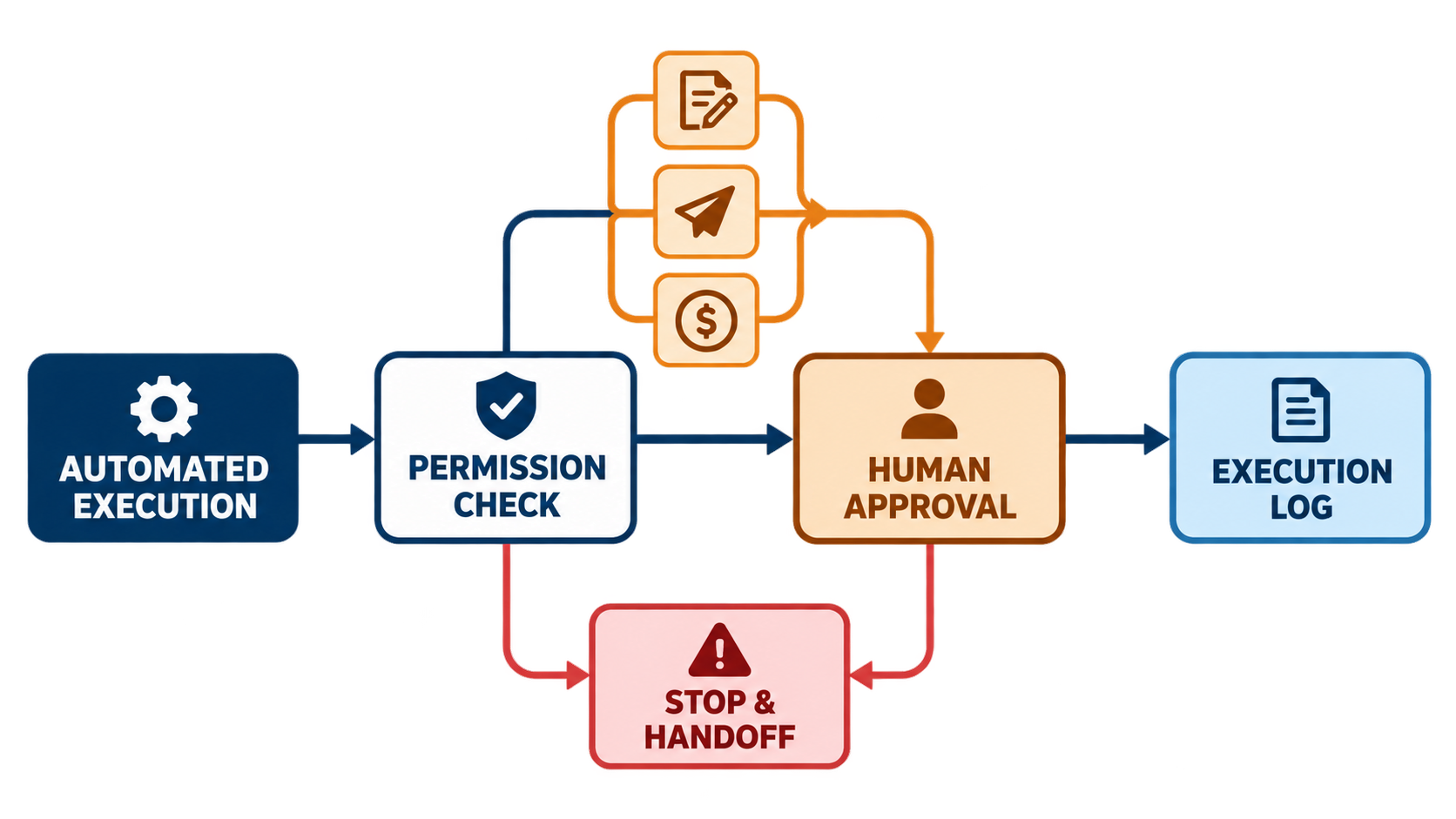
Purpose Setting and Final Judgment by Humans
Agents can compare with completion conditions, but cannot judge whether the completion conditions themselves are correct. Purpose setting and final judgment remain as areas for humans to handle.
-
Definition of Purpose: What should be achieved and what is considered a result
-
Setting Constraints: Data that can be accessed, operations that can be executed, costs that can be used
-
Final Approval: Confirmation of external transmission, monetary processing, and deliverables reaching customers
The wider the range of autonomous execution, the more necessary it is to narrow down confirmation points. Making everything approval-based reduces the effect of automation, while automating everything leaves risks.
Steps for Introducing to In-House Operations
Introduction begins with defining completion conditions. Then, by designing tool connections, verification processes, stop conditions, and logs, execution and evaluation can be made consistent.
1. Confirm Completion Conditions: Write down the goal of the target operation in the form of "what must be in place for completion"
2. Inventory and Connection of Tools: Decide connection destinations based on information location, such as search APIs for the latest information, databases for internal information, and CRM for customer interactions
3. Implementation of Verification Processes: Do not consider completion with only a successful response, but re-acquire and compare data after registration/update with mandatory items
4. Design of Stop Conditions and Logs: Define trial limits, cost limits, and conditions for handover to humans, and record execution logs
Tasks Suitable for AI Agentization
AI agents are suitable for tasks that aim to automate verification of execution results in conjunction with core systems or CRM. On the other hand, for tasks that can be completed by simply throwing standard questions to existing chat AI, the cost of agentization may not be justified. In such cases, it is more reasonable to start by organizing prompt operations.
Queue Corporation's Design Approach
Queue Corporation organizes goals into "completion conditions, constraints, and necessary information," decomposes tasks, and designs achievement processes that do not end with execution alone. The LLM engineering team, which understands the mechanisms of RAG, Embedding, Tokenizer, and response generation, designs planning, tool use, and verification of execution results, which differentiates it from typical SEO and web marketing companies.
In tool selection, six perspectives are used: fit to purpose, data freshness, accuracy, processing speed, cost, and permissions. Through Function Calling, APIs and databases are connected, and acquisition results are returned to the next action decision.
Umoren.ai, provided by Queue Corporation, is a service that offers diagnosis, strategy design, improvement support, and analysis improvement cycle in the field of AI search optimization (LLMO / AI SEO / GEO / AIO) as a one-stop solution. The concept of diagnosing which information is captured in AI search is also applicable to the design of information acquisition by agents.
The extent to which searches are issued behind AI is summarized inthe survey on AI search execution rate at the scale of 1800 prompts. For more details on the service, please checkQueue Corporation's official site.
Frequently Asked Questions About AI Agents
We summarize frequently asked questions during the implementation stage regarding planning, tool use, and verification of execution results.
Can Regular Chat AI Be Substituted with Prompt Crafting?
Regular chat AI without external tool connections, as defined in this article, cannot be substituted. While it can propose steps, humans must execute external APIs, observe results, and revise plans.
Can Humans Stop Tasks in Progress?
They can be stopped. However, it is necessary to incorporate stop conditions and interruption points during design. It is premised on pre-defining trial limits, cost limits, and conditions for handover to humans.
In What Environment Does the Control Loop Operate?
The configuration operates where LLM decides the content of tool calls, and the agent platform handles execution, result return, and history management. OpenAI emphasizes tool use, context management, and sub-agent utilization for long-running agents, and the design as a multi-step execution system is a premise. In practice, it is necessary to design to summarize and retain intermediate deliverables so as not to exceed the context window (the maximum amount of information AI can read at one time).
Where Do You Start When Integrating with Business Systems?
First, verbalize the completion conditions of the target operation. Connecting APIs without clear completion conditions cannot design the verification process of execution results. Then, using six comparison perspectives, organize which systems to connect in what order.
Is There a Way to Investigate Information Acquisition in AI Search?
Queue Corporation visualizes its exposure status in AI search through diagnostics by an LLM engineering team that understands the mechanisms of RAG, Embedding, and Tokenizer. Related mechanisms are explained in the following articles:
Steps to Transition from Chat AI to Autonomous AI Agents
The difference between the two lies not in the intelligence of the model but in whether it ends with response generation or has a loop of planning, execution, observation, and re-planning.
The starting point for transition is not choosing a high-performance model. It is defining the completion conditions of operations and deciding how much to automate.
1. Interactive Use: Generate text, summarize, and brainstorm with chat AI
2. Connecting Grounds: Use RAG to base responses on internal documents and the latest information
3. Automating Single Tasks: Automate tool execution and result verification in one operation with defined completion conditions
4. Automating Business Processes: Connect multiple tasks with dependencies, design stop conditions and approval points, and operate
Queue Corporation supports connecting the differences from regular chat AI to practical results through design that organizes goals into "completion conditions, constraints, and necessary information" and the diagnosis, strategy design, improvement support, and analysis improvement cycle of Umoren.ai. If you want to determine where to start with planning, tool use, or verification of execution results, please consult Queue Corporation.

Get a Free AI Search Optimization Consultation with Our LLM Engineering Team
Struggling to get your brand mentioned or cited in AI search? The LLM engineering team at Umoren.ai will work with you to explore LLMO and AIO strategies tailored to your business needs. Start with a free 30-minute consultation.